
Building a Smart Command Center for a City: Real-Time Decisioning at Scale
Overview
A rapidly growing Tier-2 city in South-Central India faced increasing complexity across traffic, public safety, emergency response and civic services. The city partnered with Magellanic Cloud Limited to implement a city-wide Integrated Command and Control Center (ICCC) powered by Scanalitix, with the goal of unifying fragmented operations and enabling real-time decision-making.
The City Context
The city had a population exceeding one million and was experiencing rapid urban expansion. Traffic management, law enforcement, municipal services and emergency response often operated independently, relying on manual processes and delayed communication. This fragmentation affected operational efficiency and citizen experience.
The Challenge
Administrators lacked a centralized view across departments and key city zones. Incident response could be delayed by manual intervention; real-time visibility was limited; field resources were deployed reactively; and existing digital initiatives needed a scalable architecture aligned with long-term smart-city goals.
The Solution
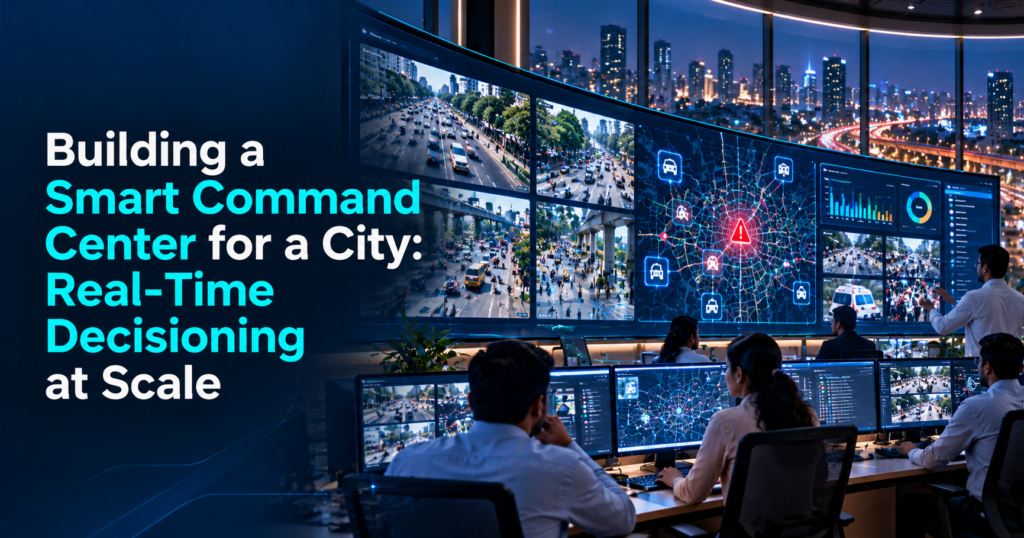
Magellanic Cloud deployed a city-wide ICCC using Scanalitix as a unified intelligence layer. The center brought multiple data streams into a single interface for monitoring, coordination, analytics and response.
Key Capabilities Implemented
The system integrated city surveillance feeds, traffic systems and civic infrastructure data. AI video analytics supported detection of traffic violations, crowd-density anomalies and suspicious activities. Automated incident workflows routed alerts to relevant departments. Real-time dashboards provided operational metrics, while mobile-enabled workflows connected field teams with command-center operators. The architecture was designed to support future modules.
Implementation
The rollout included five phases: assessment of existing traffic, surveillance and municipal systems; setup of a centralized command center with video walls and real-time data processing; integration of CCTV networks, traffic signals, emergency helplines and civic databases; deployment of AI models and automated workflows; and training of city officials with standard operating procedures for interdepartmental coordination.
The Impact
The case study reports a 35% reduction in incident response time. It also describes improved traffic-management efficiency, enhanced public safety, better use of field and municipal resources, and increased administrative visibility.
Business and Governance Impact
The ICCC helped shift decision-making from reactive to more predictive operations. Departments that previously worked in silos could coordinate through a shared platform. The city gained a scalable digital foundation for future initiatives such as environmental monitoring and citizen-engagement services.
Why It Matters
Integrated command centers can help cities improve public safety and emergency response, optimize traffic and mobility, coordinate departments, improve citizen experience and build scalable digital infrastructure.