
AI That Filters Noise: Turning Surveillance Alerts into Actionable Intelligence
Overview
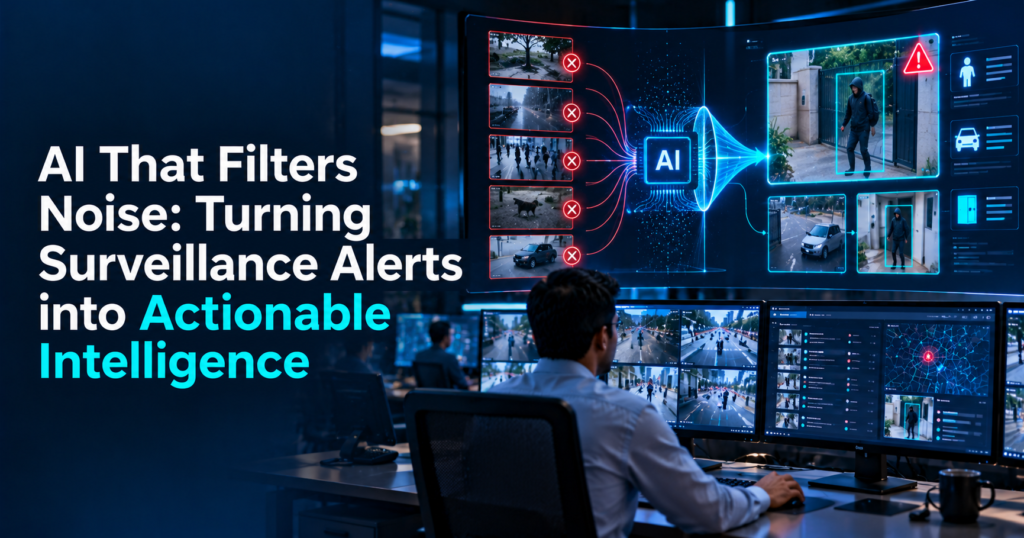
Traditional surveillance systems can generate overwhelming numbers of motion alerts, many of which are false positives. Scanalitix is presented as an AI-powered approach that filters irrelevant activity, prioritizes critical events and supports faster, more accurate responses.
The Client
The client is a multi-site enterprise managing large-scale surveillance infrastructure across facilities. It wanted to improve monitoring efficiency, reduce alert fatigue and strengthen security outcomes.
The Challenge
Conventional CCTV systems generated alerts from irrelevant motion such as shadows, weather and routine activity. The volume of false positives caused alert fatigue, delayed responses and increased the risk of missing real incidents. Manual monitoring also limited scalability and operational efficiency.
The Solution
Scanalitix deployed an AI-powered video analytics platform with four core capabilities: AI-based event filtering to remove irrelevant alerts and highlight potential threats; behavioural analytics to identify suspicious patterns beyond basic motion detection; real-time alerting for critical incidents; and a centralized dashboard/video management system for unified monitoring and control.
Implementation
The platform was integrated with the client’s existing camera network using a hardware-agnostic approach. AI models were configured to detect intrusion, loitering and unauthorized access while filtering environmental noise. Alerts were consolidated through a centralized dashboard, and continuous-learning models were used to improve detection accuracy over time.
Results
The published case study reports an 85–90% reduction in false alerts, 60% faster incident response time, a 70% improvement in monitoring efficiency and more than 95% accuracy in threat detection.
Business Impact
By reducing false positives, the platform helped monitoring teams focus on critical events rather than repeated irrelevant notifications. Faster response and improved accuracy strengthened risk management, while automation supported more scalable and cost-efficient surveillance operations.