How Personal Digital Banking Is Enabling Hyper-Personalisation at Scale?
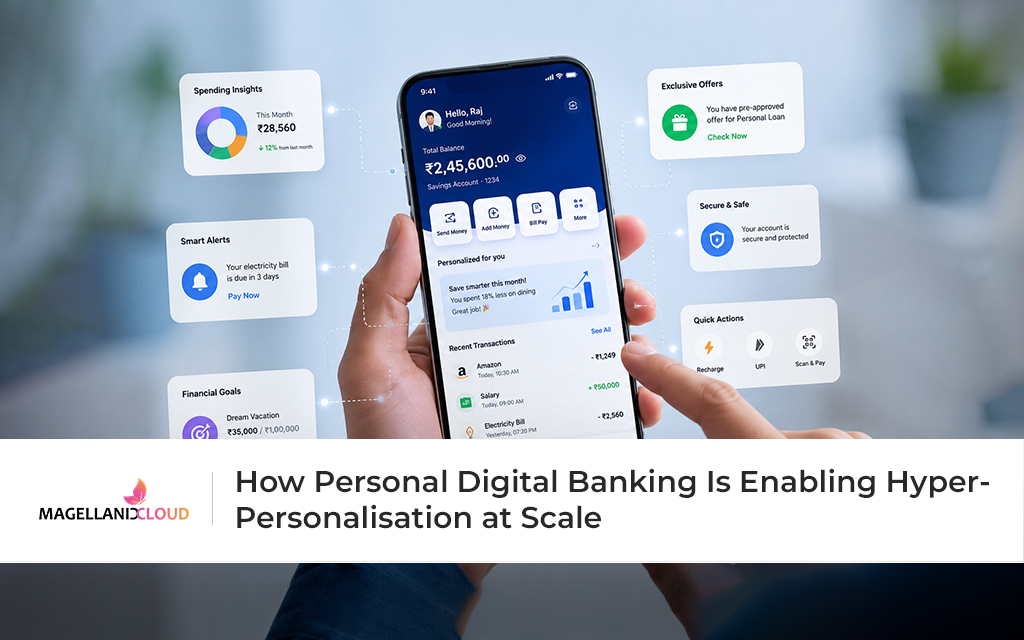
Think about the last time you opened your banking app.
Did it simply show your account balance, or did it remind you about an upcoming bill, recommend an investment based on your spending habits, or alert you to unusual activity before you even noticed it yourself?
Today’s customers expect banks to do more than process transactions. They expect them to anticipate needs, simplify financial decisions, and deliver experiences that feel personal rather than transactional.
This shift lies at the heart of personal digital banking.
As financial institutions embrace digital transformation in banking, they are moving beyond one-size-fits-all services toward hyper-personalised experiences powered by artificial intelligence, data analytics, automation, and cloud technologies. Whether it is recommending the right savings plan, approving loans faster, detecting fraud in real time, or offering tailored financial advice, personal digital banking is redefining how customers interact with financial institutions.
The evolution of personal digital banking in India reflects this broader transformation. Banks are no longer competing solely on interest rates or branch networks. They are competing on experience, speed, intelligence, and trust.
Digital Banking 2.0 is about creating financial ecosystems that understand every customer individually and deliver personalised services at scale.
What Is Personal Digital Banking?
At its core, personal digital banking refers to delivering customised banking experiences through digital channels based on a customer’s financial behaviour, preferences, goals, and real-time needs.
Traditional banking treated every customer within broad segments. A salaried employee, a business owner, and a student often received similar product recommendations despite having entirely different financial priorities.
Modern digital banking transformation replaces this generic approach with data-driven intelligence. This enables banks to recommend relevant products, personalise financial advice, automate customer support, and provide contextual services exactly when customers need them.
Hyper-personalisation is rapidly becoming the defining characteristic of banking digital transformation.
Why Digital Transformation in Banking Has Become a Business Imperative
Customer expectations have changed dramatically over the last decade.
Consumers compare banking experiences with platforms like Amazon, Netflix, Uber, and Google rather than with other banks. They expect instant onboarding, personalised recommendations, seamless digital journeys, and proactive service.
This expectation has accelerated digital transformation banking initiatives across the global financial sector.
According to McKinsey & Company, banks that effectively personalise customer engagement can significantly improve customer satisfaction, increase product adoption, and generate stronger long-term revenue growth.
The pressure is even greater in emerging markets like India, where digital adoption continues to accelerate.
According to the Reserve Bank of India (RBI), digital payments in India have grown exponentially, making the country one of the world’s fastest-growing digital financial ecosystems.
As personal digital banking becomes increasingly usual, institutions must deliver experiences that feel personalised, secure, and effortless across every customer interaction.
Digital Banking in India Is Entering Its Next Phase
India has already transformed how people move money.
UPI has made instant payments a part of everyday life. Opening a digital bank account now takes minutes instead of days. Customers expect 24×7 access to financial services through mobile applications without ever visiting a physical branch.
However, the next phase of digital banking in India extends far beyond convenience.
The focus is shifting toward intelligent banking.
Banks are increasingly using artificial intelligence to analyse spending habits, predict financial behaviour, identify fraud, automate customer service, and personalise financial products in real time.
Imagine receiving an investment recommendation immediately after your salary is credited because your savings pattern indicates surplus income. Or being offered travel insurance moments after booking an international flight.
These experiences represent the future of banking and digital transformation, where financial services become proactive rather than reactive.
Hyper-Personalisation Is Built on Data, AI, and Trust
Hyper-personalisation is often mistaken for targeted marketing.
In reality, it is much broader.
It involves continuously analysing customer behaviour using artificial intelligence, machine learning, predictive analytics, and real-time data to create meaningful financial experiences.
Every interaction contributes to building a dynamic customer profile.
Payment habits. Income patterns. Investment preferences. Risk appetite. Loan repayment history. Life events. Location-based behaviour.
Instead of overwhelming customers with generic offers, banks can provide relevant financial guidance based on their immediate context.
According to Accenture, financial institutions that successfully implement AI-powered personalisation improve customer engagement while strengthening long-term customer loyalty.
However, personalisation depends on trust.
Customers are willing to share financial data only when they believe it will be handled securely and ethically.
This is why privacy, cybersecurity, regulatory compliance, and responsible AI have become foundational pillars of digital transformation banking industry initiatives worldwide.
The Technologies Behind Banking Digital Transformation
Hyper-personalised banking experiences are powered by a combination of advanced technologies rather than a single innovation.
Artificial intelligence helps predict customer needs, automate decision-making, and improve fraud detection. Machine learning continuously refines recommendation engines by learning from customer interactions. Cloud computing enables banks to scale digital services rapidly while improving operational agility. Data analytics transforms millions of financial transactions into actionable customer insights.
Open APIs connect banks with fintech companies, insurance providers, investment platforms, and payment ecosystems.
Together, these technologies form the backbone of bank digital transformation, allowing financial institutions to move from product-centric operations to customer-centric ecosystems.
Rather than offering financial products, banks are increasingly delivering personalised financial experiences. That distinction defines Digital Banking 2.0.
From Products to Financial Ecosystems
The role of banks is changing.
Traditionally, financial institutions focused on individual products such as savings accounts, loans, insurance, and investments.
Today, customers expect all these services to work together seamlessly.
A single mobile application may allow users to open a digital bank account, manage investments, apply for loans, purchase insurance, pay utility bills, monitor spending habits, and receive personalised financial insights in one integrated experience.
This evolution reflects the broader trend of digital transformation in banking, where banks are becoming financial lifestyle platforms rather than standalone service providers.
As customer expectations continue to rise, the ability to deliver relevant, personalised, and intelligent experiences at scale will increasingly determine which institutions lead the next era of digital finance.
From Products to Financial Ecosystems
When people think of digital banking, they often imagine a mobile application that allows them to transfer money or check their account balance. While these remain essential services, the types of digital banking available today have expanded significantly.
Customers can now access fully digital banks that operate without physical branches, mobile-first banking platforms, internet banking portals, embedded banking services integrated into third-party applications, and AI-powered wealth management platforms. Open banking ecosystems are also enabling customers to securely connect multiple financial services through a single interface.
This evolution is changing the role of financial institutions. Banks are no longer isolated service providers. They are becoming part of larger digital ecosystems where payments, lending, investments, insurance, and financial planning work together seamlessly.
The next stage of digital banking transformation is going to be defined by how intelligently those services adapt to each individual’s financial journey.
Artificial Intelligence Is Making Banking Truly Personal
Hyper-personalisation would not be possible without artificial intelligence.
Every day, banks process millions of transactions, customer interactions, credit histories, and behavioural signals. Hidden within this vast amount of data are patterns that can reveal customer intent, financial goals, spending habits, and potential risks. AI enables banks to identify these patterns in real time and convert them into meaningful customer experiences.
Instead of sending the same promotional message to every customer, AI can recommend a home loan to someone actively searching for properties, suggest an investment portfolio based on savings behaviour, or alert customers when unusual spending patterns indicate possible fraud.
Customer service has also become significantly more intelligent. AI-powered virtual assistants can answer queries instantly, guide users through financial processes, and escalate only complex issues to human advisors. This improves response times while allowing relationship managers to focus on high-value customer interactions.
Beyond customer engagement, AI is transforming risk management, regulatory compliance, fraud detection, and credit assessment. By analysing thousands of variables simultaneously, financial institutions can make faster and more informed decisions without compromising security.
This is why banking and digital transformation increasingly revolves around intelligence rather than digitisation alone.
The Challenge of Scaling Hyper-Personalisation
While the vision of personalised digital banking is compelling, achieving it across millions of customers is far from simple.
Each customer generates enormous volumes of financial and behavioural data every day. Processing this information in real time requires scalable cloud infrastructure, advanced analytics platforms, secure data governance, and AI models capable of learning continuously.
Financial institutions must also balance innovation with regulatory compliance. Personalisation cannot come at the cost of customer privacy. Banks are expected to comply with stringent data protection regulations while maintaining transparency in how customer information is collected, analysed, and used.
Cybersecurity presents another critical challenge. As banking becomes increasingly digital, protecting sensitive financial data from evolving cyber threats becomes just as important as delivering seamless customer experiences.
For many banks, the biggest challenge is not adopting new technology. It is integrating legacy systems with modern digital platforms while maintaining uninterrupted customer service.
The institutions that succeed will be those that view digital transformation banking as an ongoing strategic capability rather than a one-time technology project.
How Finoux and Magellanic Cloud Are Enabling Digital Banking 2.0
As financial institutions accelerate their digital transformation journeys, they require technology partners capable of combining AI, cloud, automation, and analytics into scalable enterprise solutions.
This is where Magellanic Cloud Limited and its fintech subsidiary Finoux are helping shape the future of personal digital banking.
Finoux specialises in AI-driven wealth management, robo-advisory solutions, financial automation, and intelligent investment platforms that enable institutions to deliver personalised financial services at scale. By combining predictive analytics with customer-centric digital experiences, Finoux helps organisations move beyond transactional banking towards advisory-led financial ecosystems.
Together, they support financial institutions, and fintech organisations in building secure, scalable, and intelligent platforms that align with the evolving expectations of today’s digitally connected customers.
The objective is simple yet transformative: enable every financial interaction to become smarter, faster, and more relevant.
The Future of Digital Banking Belongs to Intelligent Experiences
The next decade will not be defined by which bank has the largest branch network or the most mobile app downloads.
It will be defined by which institution understands its customers best.
Hyper-personalisation will continue evolving through generative AI, conversational banking, embedded finance, real-time financial coaching, biometric authentication, and predictive wealth management. Customers will increasingly expect banks to anticipate their needs, simplify complex financial decisions, and provide guidance throughout every stage of their financial lives.
The convergence of AI, cloud computing, open banking, and advanced analytics will create financial ecosystems that are not only digital but also deeply intelligent.
For banks, this represents a significant opportunity. Those that invest in digital transformation in banking today will be better positioned to build stronger customer relationships, improve operational efficiency, and create new sources of long-term growth.
Digital Banking 2.0 is no longer about offering services through digital channels.
It is about creating financial experiences that feel personal, proactive, and human.
Frequently Asked Questions - FAQs
Q1. What is digital transformation in banking?
Ans: Digital transformation in banking refers to the integration of technologies such as artificial intelligence, cloud computing, automation, analytics, and digital platforms to improve banking operations, enhance customer experiences, streamline processes, and create new digital financial services.
Q2. What is a bank digital transformation strategy?
Ans: A bank digital transformation strategy is a long-term roadmap that enables financial institutions to modernise legacy systems, adopt digital technologies, improve operational efficiency, strengthen cybersecurity, personalise customer experiences, and remain competitive in an increasingly digital financial landscape.