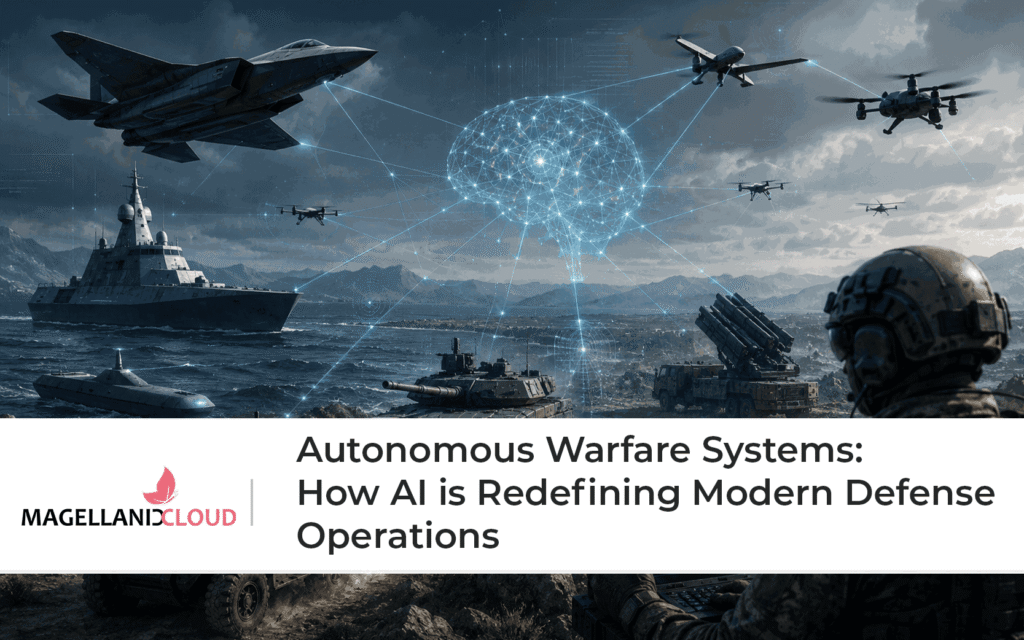
What happens when warfare no longer depends entirely on human decision-making?
For decades, military strength was measured by troop numbers, firepower, and strategic positioning. Today, however, another force is rapidly reshaping modern defense operations-artificial intelligence. Autonomous warfare systems powered by AI are changing how militaries detect threats, gather intelligence, conduct surveillance, and even execute combat operations.
From AI-enabled drones and autonomous submarines to intelligent surveillance platforms and robotic combat vehicles, defense organizations worldwide are accelerating investments in military AI technologies. The goal is clear: achieve faster decision-making, reduce human risk, improve operational efficiency, and gain a strategic advantage on the battlefield.
And the numbers highlight just how rapidly this transformation is unfolding.
The global autonomous weapons market is projected to grow from USD 11.5 billion in 2020 to over USD 30.1 billion by 2030, expanding at a CAGR of 10.4%. Simultaneously, the global military drone (UAV) market is expected to rise from USD 15.8 billion in 2025 to USD 22.8 billion by 2030. These figures underline a growing reality-AI is no longer a supporting tool in defense operations; it is becoming central to military strategy itself.
What Are Autonomous Warfare Systems?
Autonomous warfare systems refer to military technologies capable of performing tasks with limited or no direct human intervention. These systems use artificial intelligence, machine learning, computer vision, sensor fusion, and advanced analytics to process information, identify targets, and make operational decisions in real time.
Examples of autonomous military systems include:
- AI-powered combat drones
- Autonomous ground vehicles
- Robotic surveillance systems
- Smart missile defense platforms
- Unmanned naval vessels
- AI-assisted battlefield intelligence systems
Unlike conventional defense systems, autonomous warfare technologies can rapidly analyze massive volumes of battlefield data, detect threats, and respond faster than human-operated systems.
This ability is particularly critical in modern combat environments where speed, precision, and situational awareness determine operational success.
Why AI Is Becoming Critical in Modern Defense Operations
Modern warfare has evolved far beyond traditional combat scenarios. Defense organizations today must deal with cyber warfare, drone swarms, border surveillance, electronic warfare, and rapidly changing threat environments.This is where AI in defense operations is becoming indispensable.
Faster Decision-Making : One of the biggest advantages of autonomous warfare systems is their ability to process data at extraordinary speed. AI algorithms can analyze satellite imagery, radar feeds, communication signals, and battlefield intelligence within seconds.
In military operations, faster decisions can significantly improve mission outcomes while minimizing casualties.
Enhanced Surveillance and Reconnaissance : AI-powered military drones and autonomous surveillance systems can monitor large geographic areas continuously without fatigue. Advanced computer vision technologies help identify suspicious activities, track targets, and detect anomalies in real time. This enables defense forces to strengthen border security, maritime surveillance, and intelligence gathering capabilities.
Reduced Human Risk : Autonomous defense systems are increasingly being deployed in high-risk combat zones where human involvement may be dangerous. Unmanned systems can carry out reconnaissance missions, bomb disposal operations, and surveillance activities while keeping military personnel out of direct harm. This shift is fundamentally changing how defense operations are planned and executed.
The Rise of AI-Powered Military Drones
Among all autonomous warfare technologies, military drones have emerged as one of the most significant innovations.
AI-powered UAVs are now capable of performing:
- Real-time surveillance
- Target acquisition
- Threat assessment
- Precision strikes
- Autonomous navigation
The increasing adoption of drone warfare is reflected in market projections. The global military drone market is forecasted to grow from USD 15.8 billion in 2025 to USD 22.8 billion by 2030.
Modern defense agencies are investing heavily in drone swarms, autonomous reconnaissance systems, and AI-enabled combat drones that can operate collaboratively with minimal human intervention.
These technologies are enabling militaries to execute missions with greater precision, flexibility, and operational efficiency.
Global Defense Spending on Autonomous Warfare Technologies
Governments worldwide are significantly increasing investments in AI-powered defense systems.
One major example is the Defense Autonomous Warfare Group, responsible for the development of drones for the Pentagon. According to reports, the group could receive a dramatic funding increase in the proposed fiscal year 2027 budget. Its funding may rise from USD 225.9 million this fiscal year to nearly USD 54 billion.
Such large-scale investments clearly indicate that autonomous warfare systems are becoming a strategic priority for military modernization programs globally.
Countries including the United States, China, Russia, Israel, and the United Kingdom are actively accelerating AI integration into defense infrastructure.
The growing competition in military AI capabilities is also reshaping geopolitical dynamics, pushing nations to strengthen technological superiority in future warfare.
How Autonomous Warfare Systems Are Transforming Battlefield Operations
AI-driven warfare technologies are not just changing weapons-they are transforming entire defense ecosystems.
Intelligent Target Recognition : Advanced AI systems can identify and classify objects, vehicles, or enemy movements with greater accuracy. This improves precision targeting while reducing operational errors.
Predictive Threat Analysis: Machine learning models can analyze historical and real-time intelligence data to predict potential threats before they escalate. This proactive defense approach enables military forces to improve strategic planning and mission readiness.
Autonomous Coordination: Future battlefield operations may involve coordinated fleets of autonomous drones, robotic vehicles, and surveillance systems working together through AI-driven communication networks. This interconnected defense ecosystem could significantly improve operational speed and battlefield adaptability.
Cyber Defense Integration : Autonomous defense systems are also strengthening cybersecurity operations. AI can rapidly detect cyber threats, identify vulnerabilities, and respond to attacks faster than traditional security mechanisms. As cyber warfare becomes increasingly sophisticated, AI-powered cyber defense solutions are becoming essential for national security.
Ethical and Strategic Challenges of Autonomous Warfare
While autonomous warfare systems offer significant operational advantages, they also raise complex ethical and strategic concerns.One major debate centers around the level of human control in AI-driven combat systems. Questions continue to emerge around accountability, decision-making authority, and the risks associated with fully autonomous lethal weapons.
There are also concerns regarding:
- AI system vulnerabilities
- Cybersecurity risks
- Misidentification of targets
- Escalation of autonomous conflicts
- International regulatory gaps
As AI continues to evolve, governments and defense organizations will need to establish clear policies and ethical frameworks governing the deployment of autonomous military technologies. Balancing innovation with responsible AI governance will be critical for the future of defense operations.
Future Outlook: The Next Era of AI-Powered Warfare
The future of autonomous warfare systems will likely extend far beyond drones and robotic vehicles.
Emerging technologies such as generative AI, including AI video maker tools used for simulation, training, and visualization, along with edge computing, quantum computing, and advanced sensor networks, are expected to further enhance military AI capabilities.
Future autonomous defense systems may include:
- Fully autonomous combat missions
- AI-driven military simulations
- Smart battlefield coordination platforms
- Autonomous underwater warfare systems
- Predictive military intelligence ecosystems
As defense agencies continue investing in AI innovation, autonomous warfare technologies are expected to become faster, smarter, and more interconnected.At the same time, global discussions around AI ethics, defense regulations, and international security policies will intensify.The future battlefield may not simply be defined by physical weapons-but by algorithms, data intelligence, and autonomous decision-making systems.
In the End
Autonomous warfare systems are no longer futuristic concepts-they are actively redefining modern defense operations.
From AI-powered military drones and intelligent surveillance systems to predictive threat analysis and autonomous combat technologies, artificial intelligence is transforming how nations approach defense strategy and battlefield operations.
The rapid growth of the autonomous weapons market, rising investments in military AI, and increasing deployment of autonomous systems all point toward one reality: AI is becoming a defining force in the future of warfare.
However, as defense organizations continue to embrace AI-powered military technologies, the focus must remain on responsible innovation, ethical governance, and strategic oversight.
Because in the age of autonomous warfare, technological superiority alone will not define success-how intelligently and responsibly these systems are deployed will matter just as much.