Your Next Banker Won’t Be Human: The Rise of AI-First Financial Services
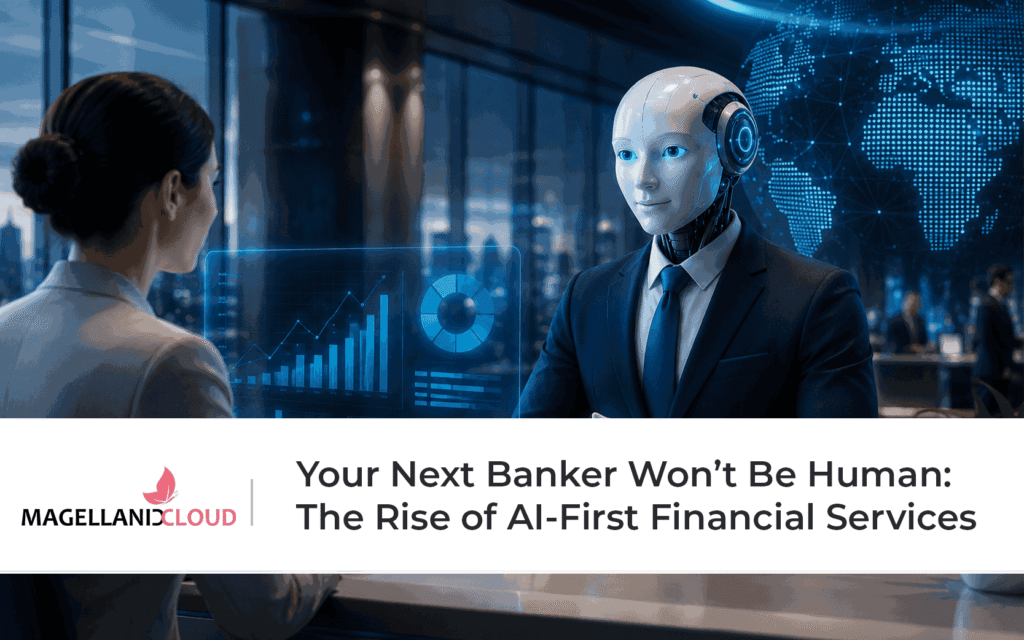
A few years ago, getting financial advice meant walking into a branch, booking an appointment, and sitting across from someone in a tie explaining investment products with a stack of printed brochures.
Today, a 24-year-old first-time investor in Jaipur opens an app at midnight and receives personalised portfolio suggestions within seconds. A salaried professional in Bengaluru gets real-time alerts warning about unusual spending patterns before fraud even occurs. A small business owner in Surat secures credit approval within minutes based on AI-driven cash flow analysis rather than traditional paperwork.
No queues. No paperwork. No human banker.
This is not the future of finance anymore. It is the beginning of an AI-first financial ecosystem, where algorithms increasingly drive decisions once handled exclusively by humans.
And in India, this transformation is accelerating faster than almost anywhere else in the world.
Finance Is Becoming Intelligent, Not Just Digital
The first wave of fintech digitised banking. Payments moved online. UPI transformed transactions. Banking apps replaced branch visits.
The second wave is different. It is not just about moving services online. It is about making those services intelligent.
Artificial intelligence is now powering:
- robo-advisory platforms
- fraud detection systems
- hyper-personalised financial recommendations
- automated lending decisions
- predictive financial planning
According to McKinsey & Company, AI technologies could generate substantial productivity gains across banking and financial services through automation and advanced analytics.
The shift is clear. Banking is evolving from transactional systems into predictive ecosystems.
Why AI-First Finance Is Rising So Quickly in India
India presents the perfect environment for AI-first financial services.
The country has:
- one of the world’s largest digital payment ecosystems
- rapidly growing retail investor participation
- increasing smartphone penetration
- expanding fintech adoption across urban and semi-urban markets
UPI processed billions of monthly transactions, fundamentally changing how Indians interact with money. This digital familiarity has created trust in app-based financial systems.
At the same time, millions of Indians are entering formal financial markets for the first time. According to data from the National Stock Exchange (NSE), retail investor participation has surged dramatically in recent years.
Traditional banking models struggle to personalise services for such a vast and diverse customer base. AI changes that equation.
Hyper-Personalisation: The New Competitive Advantage
Traditional financial products often treated customers as segments. Salaried professionals received one set of offerings. Business owners received another.
AI-first systems go far deeper.
Modern AI models analyse:
- spending behaviour
- savings patterns
- income volatility
- investment preferences
- risk appetite
- life-stage indicators
This allows platforms to deliver highly personalised financial recommendations in real time.
According to Accenture, hyper-personalisation is becoming a defining competitive advantage in banking and financial services. A user planning for retirement receives different investment guidance than a first-time salaried employee building emergency savings. The system adapts continuously as financial behaviour evolves.
Finance is no longer becoming customer-centric. It is becoming individually intelligent.
The Rise of Robo-Advisory
Wealth management was once reserved for affluent clients with access to private advisors and investment firms. Robo-advisory platforms are changing that.
AI-powered advisory systems use algorithms to recommend investment strategies, rebalance portfolios, and optimise allocations based on user goals and market conditions.
This dramatically lowers entry barriers for retail investors.
According to Deloitte, robo-advisory adoption is expanding globally as younger investors increasingly prefer digital-first financial experiences.
In India, where millions of new investors are entering financial markets, robo-advisory has the potential to democratise access to wealth management at scale.
Embedded Finance: Banking Without Banks
One of the biggest shifts in fintech is the rise of embedded finance.
Financial services are increasingly being integrated directly into non-financial platforms. Consumers no longer need separate banking journeys because financial capabilities now exist inside apps they already use.
Loans appear during checkout. Insurance becomes part of travel bookings. Investment recommendations surface inside payment apps.
According to Bain & Company, embedded finance is expected to become one of the fastest-growing segments within digital financial services.
AI plays a critical role here. It determines which financial product to offer, when to offer it, and how to personalise it based on behavioural insights.
Banking is moving from destinations to invisible infrastructure.
AI Advisors vs Human Advisors
The question is no longer whether AI can support financial decisions. It already does.
The bigger question is whether AI can replace traditional advisors entirely.
The answer is nuanced.
AI systems excel at:
- analysing large datasets
- identifying patterns
- optimising portfolios
- automating repetitive processes
- providing 24/7 recommendations
However, human advisors still matter in emotionally complex financial situations involving trust, uncertainty, and long-term planning.
The future is likely hybrid: AI handles speed and scale, while humans provide contextual judgment and relationship-building.
The real transformation is not “AI versus humans.” It is “AI-first, human-supported.”
Trust, Governance, and the Risks Ahead
As AI takes on greater responsibility in finance, concerns around transparency, privacy, and governance become increasingly important.
AI systems influence lending decisions, investment strategies, and fraud detection mechanisms. Without proper oversight, bias or inaccurate predictions could create serious consequences.
The OECD stresses that trustworthy AI systems must ensure fairness, explainability, and accountability.
Similarly, India’s regulatory landscape is evolving to strengthen digital financial governance and consumer protection.
Trust will ultimately determine how deeply consumers embrace AI-driven finance.
Finoux and Magellanic Cloud: Building Intelligent Financial Ecosystems
At Magellanic Cloud, we believe the future of finance lies in intelligent, scalable, and accessible digital ecosystems.
Through Finoux, our fintech and robo-advisory platform, we focus on enabling AI-driven financial experiences designed for modern investors and digital consumers.
Finoux leverages:
- predictive analytics for personalised recommendations
- AI-powered portfolio insights
- real-time financial intelligence
- scalable digital advisory frameworks
By integrating AI with cloud-native infrastructure and analytics capabilities, Finoux enables financial platforms that are responsive, adaptive, and user-centric.
Magellanic Cloud’s broader expertise in AI, digital engineering, and data infrastructure strengthens this ecosystem, allowing financial institutions to transition from traditional digital banking toward truly intelligent finance.
Our vision is simple: finance should not just be digital. It should be predictive, personalised, and proactive.
The Future of Banking Is Invisible
The most disruptive technologies often disappear into everyday life.
Electricity became infrastructure. The internet became invisible. Banking is now heading in the same direction.
Consumers increasingly expect financial systems to anticipate needs rather than wait for requests. They expect recommendations before decisions, alerts before risks, and guidance before confusion.
This is what AI-first financial services enable.
The future banker may not sit behind a desk. It may exist quietly in the background, embedded within apps, powered by algorithms, learning continuously from behaviour and context.
Conclusion: Finance Is Entering Its Intelligence Era
India’s fintech revolution began with accessibility. It is now entering a new phase driven by intelligence.
AI-first financial services are transforming how people save, invest, borrow, and manage money. Hyper-personalisation, robo-advisory, predictive analytics, and embedded finance are redefining customer expectations across the financial ecosystem.
The institutions that succeed in this new era will not simply digitise existing services. They will build systems capable of learning, adapting, and anticipating.
Because in the future of finance, intelligence will matter more than infrastructure.
And your next banker may never be human at all.