Why Enterprise AI Is Breaking Traditional Security Models
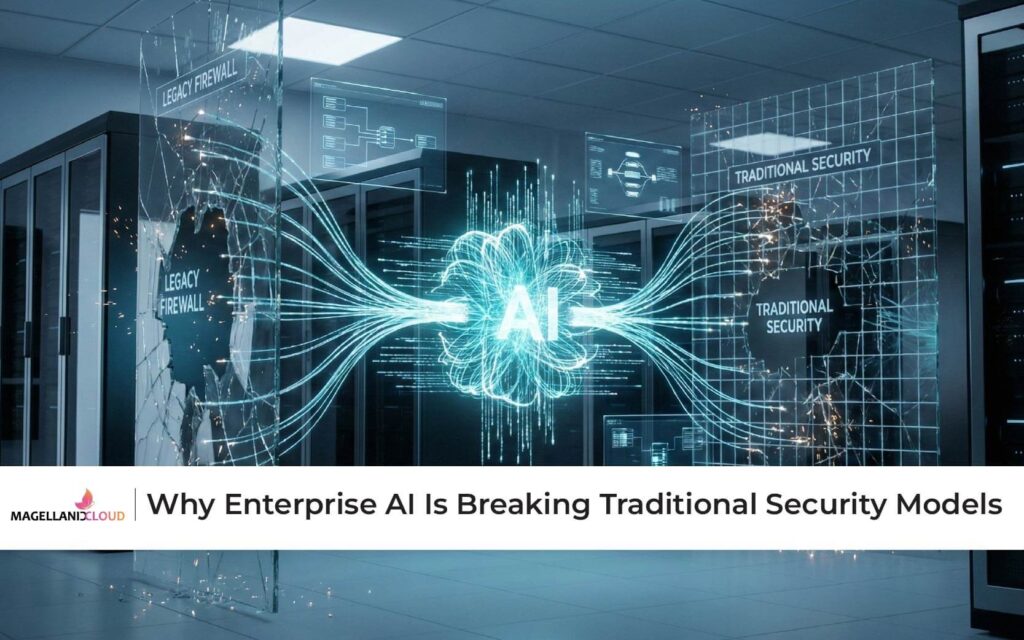
Are Traditional Security Models Prepared for Autonomous Intelligence?
What happens when machines start making decisions, accessing data, and interacting across systems faster than humans can monitor? And more importantly, what happens when traditional security frameworks, designed for static systems, are tasked with protecting dynamic, autonomous AI environments?
This is the fundamental challenge organizations face today. As Enterprise AI adoption accelerates, businesses are embedding AI into critical operations from customer engagement and fraud detection to infrastructure management and strategic decision-making, fueling a new wave of digital innovation.
However, this rapid transformation is exposing a harsh reality: traditional enterprise cybersecurity models were built to protect static systems, not autonomous, learning technologies that continuously evolve, interact across environments, and operate with minimal human oversight.
The risks are not theoretical. According to Gartner, 40% of AI data breaches will arise from cross-border GenAI misuse by 2027, highlighting how AI systems are expanding security exposure beyond traditional organizational boundaries. AI doesn’t just increase the volume of data, it changes how data is accessed, shared, and processed, fundamentally reshaping the enterprise attack surface.
The question is no longer whether AI introduces risk. The question is whether existing security models are capable of managing it.
Enterprise AI Is Expanding the Attack Surface Beyond Traditional Boundaries
Traditional security models were built around defined perimeters: networks, devices, and controlled access points. AI disrupts this model entirely.
Modern AI systems interact with vast datasets, cloud environments, APIs, and external platforms. This interconnectedness expands potential entry points for attackers, increasing exposure to AI security risks.
Unlike traditional software, AI systems continuously evolve. Machine learning models update based on new data inputs, creating dynamic environments that are difficult to monitor using conventional tools.
This evolution introduces new forms of AI security threats in corporate environments, including:
- Model manipulation
- Data poisoning attacks
- Unauthorized data access through AI integrations
- Cross-platform vulnerabilities
These threats operate differently from traditional cyberattacks, making legacy cybersecurity for AI systems insufficient.
As organizations scale AI deployments, the attack surface grows exponentially, making security more complex and difficult to manage.
Rising AI-Powered Cyber Threats Are Outpacing Traditional Defenses
Cyber attackers are evolving alongside AI. In fact, they are leveraging AI to enhance their capabilities.
According to recent research, 75% of security professionals have observed an increase in cyberattacks over the past year, many driven by automation and AI-enabled attack methods. These AI-powered cyber threats can identify vulnerabilities faster, automate phishing campaigns, and evade traditional detection systems.
Traditional security systems rely heavily on predefined threat signatures and static detection rules. However, AI-driven threats adapt dynamically, making them harder to detect and mitigate.
This is where the gap between traditional security and modern threats becomes evident. Legacy tools struggle with AI threat detection, as they were not designed to monitor autonomous decision-making systems.
AI introduces unpredictability, and traditional tools lack the intelligence required to secure intelligent systems.
The Governance Gap: Overconfidence Without Readiness
One of the most concerning aspects of Enterprise AI Security is the disconnect between perceived readiness and actual preparedness.
As per a recent report by Deloitte, only 9% of organizations achieve a “Ready” level AI governance maturity, despite 23% claiming to be highly prepared-a 14-point overconfidence gap. This gap highlights a critical vulnerability: organizations are adopting AI faster than they are securing it.
This overconfidence creates significant enterprise AI security challenges. Without proper governance, organizations risk deploying AI systems without adequate safeguards, exposing sensitive data and infrastructure.
Governance frameworks must address:
- Access control for AI systems
- Data integrity protection
- Monitoring AI model behavior
- Managing cross-platform data interactions
Without these controls, AI systems become potential entry points for attackers.
Effective enterprise AI risk management strategies must prioritize governance, visibility, and control.
Lack of Visibility Is Creating Hidden Security Vulnerabilities
Visibility is the foundation of security. Organizations cannot protect what they cannot see.
Yet, according to industry research, 86% of organizations lack visibility into AI data flows, creating significant blind spots. This lack of visibility represents one of the most critical AI security challenges in enterprises.
AI systems often operate across multiple environments-cloud platforms, third-party integrations, and internal infrastructure. These interactions create complex data flows that are difficult to track.
Without visibility, organizations cannot monitor how AI systems access data, interact with systems, or respond to inputs.
This lack of transparency increases exposure to security threats and complicates incident response.
Visibility is essential for effective AI cybersecurity, enabling organizations to detect anomalies, monitor behavior, and respond proactively.
Traditional Security Tools Are Failing Against AI-Powered Threats
Perhaps the most alarming indicator of the shift in security dynamics is the growing ineffectiveness of traditional tools.
Research shows that 68% of organizations say traditional security tools are ineffective against AI-powered threats, reinforcing the urgent need for new security approaches.
Traditional tools were designed to protect static systems with predictable behavior. AI systems, however, operate dynamically, continuously learning and evolving.
This shift requires intelligent, adaptive security solutions capable of monitoring AI behavior in real time.
The limitations of legacy tools highlight why enterprise AI security challenges cannot be addressed using conventional methods.
Security must evolve alongside AI.
How AI Is Changing Cybersecurity Models Entirely
Understanding how AI is changing cybersecurity is essential for building effective defenses.
AI introduces new operational models, including:
- Autonomous decision-making
- Continuous learning systems
- Cross-platform integrations
- Real-time data processing
These capabilities require security models that focus on behavior rather than static signatures.
Modern enterprise cybersecurity must incorporate AI-driven threat detection, behavioral analytics, and automated response mechanisms.
Security systems must be capable of identifying anomalies, detecting threats proactively, and responding instantly.
AI is not just changing business operations-it is transforming how security must function.
Building Resilient Security Frameworks for Enterprise AI
To address these emerging risks, organizations must rethink their approach to Enterprise AI Security.
Effective security strategies must include:
- AI-Aware Security Architecture:Security systems must be designed specifically for AI environments, incorporating real-time monitoring and adaptivedefenses.
- Enhanced Visibility and Monitoring:Organizations must implement tools that provide visibility into AI data flows, interactions, andbehavior.
- Strong Governance Frameworks:Governance policies must ensure responsible AI deployment, access control, and risk management.
- Proactive Threat Detection:AdvancedAI threat detection systems must identify anomalies and respond to threats proactively.
Security must evolve from reactive defense to proactive protection.
Future Outlook: Securing the Intelligent Enterprise
AI is not just transforming business-it is redefining the entire cybersecurity landscape.
The future of AI cybersecurity will be shaped by intelligent, adaptive security systems capable of protecting autonomous environments. Organizations must move beyond traditional perimeter-based security models and adopt AI-aware security frameworks.
Security strategies must prioritize visibility, governance, and intelligent threat detection.
The rise of AI presents both opportunity and risk. Organizations that proactively address Enterprise AI Security will be better positioned to harness AI’s full potential while protecting their infrastructure, data, and operations.
The question is no longer whether traditional security models are breaking.
The real question is how quickly organizations can build security models capable of protecting the intelligent enterprise of the future.