The Quiet Risk of Legacy Data Architecture
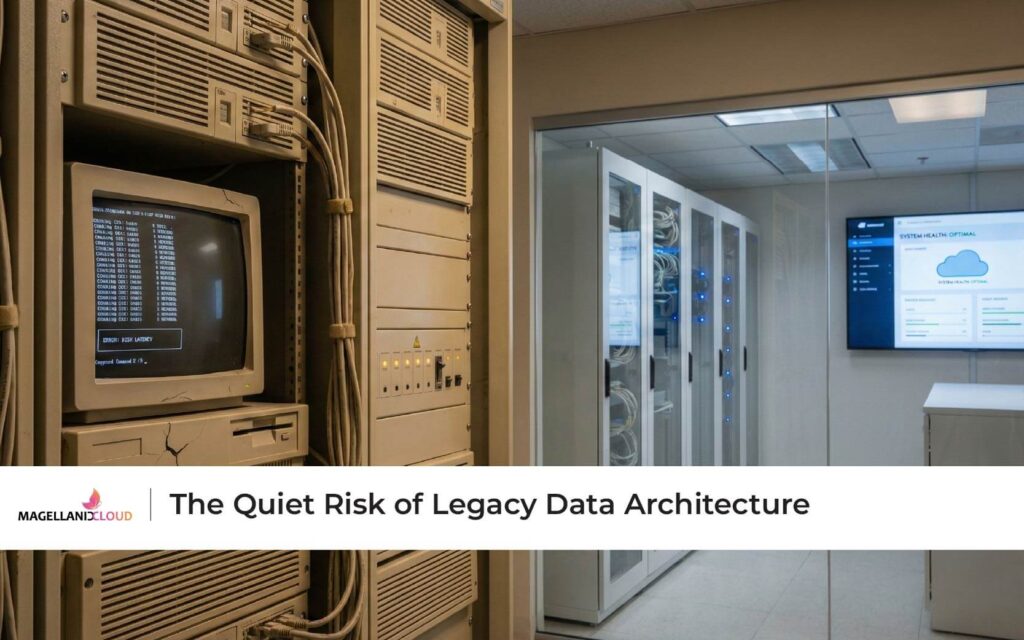
What if the biggest threat to your data strategy isn’t security, compliance, or even talent-but the architecture quietly running beneath it all?
What if your data teams are spending more time keeping systems alive than extracting value from them?
For many enterprises, this is the uncomfortable truth. Legacy data architecture continues to underpin critical business operations, even as organizations talk about AI, real-time analytics, and digital transformation. The risk isn’t loud. It doesn’t announce itself in outages or failures. Instead, it shows up subtly-through rising costs, slow innovation, and missed opportunities.
And by the time leaders notice, the damage is already embedded deep within the enterprise data architecture.
The Cost No One Budgets For
One of the most telling indicators of risk lies in how organizations spend their technology budgets.
Industry research shows that 60–80% of IT budgets are consumed by maintaining legacy infrastructure, leaving limited resources for innovation, analytics, or modernization initiatives. This isn’t just a financial imbalance-it’s a strategic one. When the majority of spend is allocated to sustaining the past, very little remains to build the future.
In organizations burdened by legacy data systems, data engineering and quality engineering costs rise steadily year over year. Teams invest in patchwork integrations, custom scripts, and manual processes just to keep data flowing. Over time, this creates a cycle where maintenance becomes the default operating mode.
This is one of the hidden risks of legacy data architecture: it locks enterprises into a cost structure that actively resists change.
Why Legacy Data Architecture Still Persists
If the risks are so well known, why does legacy data architecture remain so deeply entrenched?
Despite ongoing data modernization efforts, 62% of organizations still rely heavily on legacy software systems, with many unable to fully modernize their most critical infrastructure. These systems are often tightly coupled with business processes, making replacement feel risky and disruptive.
What starts as caution gradually becomes inertia. Leadership teams postpone decisions, hoping incremental fixes will be enough. Meanwhile, technical debt in data platforms continues to accumulate—silently increasing complexity, fragility, and cost.
This persistence explains why legacy data architecture isn’t just a technical issue. It’s an organizational one, rooted in governance models, ownership silos, and risk-averse cultures.
The Growing Price of Technical Debt
The financial impact of technical debt is far larger than most enterprises realize.
Research indicates that the average global enterprise wastes more than USD 370 million each year due to technical debt and legacy inefficiencies. These losses don’t always appear as direct expenses. Instead, they show up as:
- Delayed analytics initiatives
- Slower product launches
- Missed revenue opportunities
- Inability to operationalize AI and advanced analytics
This is why data teams spend more time on maintenance than innovation. When legacy data architecture dominates the stack, teams are forced to prioritize stability over experimentation. The cost isn’t just financial-it’s competitive.
Why Legacy Data Platforms Slow Innovation
At a structural level, legacy data architecture was never designed for today’s demands. It struggles to support:
- Real-time or near-real-time analytics
- Elastic scalability
- AI and machine learning workloads
- Self-service data access
This is the fundamental reason why legacy data platforms slow innovation. Every new initiative must navigate brittle pipelines, batch-heavy processing, and rigid schemas. Even small changes require outsized effort and coordination.
When comparing a modern data stack vs legacy architecture, the contrast is stark. Modern platforms are modular, cloud-native, and designed for continuous evolution. Legacy environments are monolithic, fragile, and resistant to change.
The longer enterprises delay modernization, the wider this gap becomes.
The Rising Risk to Analytics and AI
As organizations push deeper into advanced analytics and AI, the limitations of legacy data architecture become even more pronounced.
The impact of legacy systems on analytics and AI is significant. Data quality issues multiply. Latency increases. Model deployment cycles slow down. Governance becomes reactive instead of embedded.
AI initiatives fail not because of algorithms, but because the underlying data infrastructure cannot support them. This turns data infrastructure risk into a board-level concern-especially as AI becomes central to competitive differentiation.
Market Signals: Modernization Is No Longer Optional
The market has started to reflect this urgency.
The legacy software modernization service market is expected to grow to USD 27.3 billion by 2029, at a compound annual growth rate (CAGR) of 15.9%, driven by rising demand for modernization and operational efficiency. This growth signals a clear shift: enterprises are recognizing that postponing modernization is no longer viable.
Legacy system modernization is no longer viewed as a discretionary upgrade. It’s becoming a prerequisite for scale, resilience, and innovation.
From Maintenance to Momentum: The Role of Data Modernization
True data modernization goes far beyond migrating systems or upgrading tools. It represents a rethinking of how data creates value across the organization.
Effective data modernization addresses:
- Architecture: transitioning from monoliths to flexible, modular platforms
- Pipelines: enabling real-time and event-driven data flows
- Governance: embedding controls without slowing access
- Consumption: empowering analytics, AI, and business users
A well-executed cloud data modernization strategy allows enterprises to gradually decouple from legacy data architecture while continuing business operations uninterrupted.
This shift is essential for reducing data infrastructure costs and reclaiming innovation capacity.
Managing the Transition Without Disruption
One of the biggest misconceptions around legacy data architecture is that it must be replaced all at once. In reality, the most successful transformations are incremental.
Enterprises that modernize effectively:
- Run legacy and modern systems in parallel
- Prioritize high-impact use cases first
- Decouple data from applications
- Retire the most expensive components over time
This approach minimizes risk while steadily reducing dependence on legacy data systems. It also creates early wins that build organizational confidence and momentum.
The Quiet Risk Becomes a Strategic Decision
Left unaddressed, legacy data architecture quietly reshapes organizational behavior. Teams become reactive. Innovation slows. Costs rise predictably. Over time, what once felt stable becomes a liability.
The risk isn’t sudden failure—it’s gradual irrelevance.
Organizations that act decisively can reverse this trajectory. By addressing technical debt in data platforms and investing in modern enterprise data architecture, they move from survival mode to growth mode.
Future Outlook: Architecture Will Define Advantage
Looking ahead, the divide between modernized and legacy-bound enterprises will only widen.
As AI adoption accelerates, data volumes explode, and regulatory expectations increase, legacy data architecture will become increasingly incompatible with business needs. Enterprises that delay modernization will spend more to achieve less.
Those that invest now will be positioned to:
- Lower long-term operational and maintenance costs
- Enable real-time, intelligent decision-making
- Attract and retain modern data talent
- Transform data from a constraint into a competitive advantage
The quiet risk of legacy data architecture is no longer quiet. The future belongs to organizations that recognize it early and act before it defines them.