The GenAI Paradox in Enterprise Cloud
Introduction: Is GenAI the Enterprise Cloud’s Greatest Advantage or Its Biggest Blind Spot?
What if the very technology designed to make enterprises faster, smarter, and more efficient is also quietly making them more fragile? What if every breakthrough delivered by Generative AI in the enterprise cloud comes with an equally powerful trade-off—higher costs, blurred accountability, and risks that no dashboard fully captures?
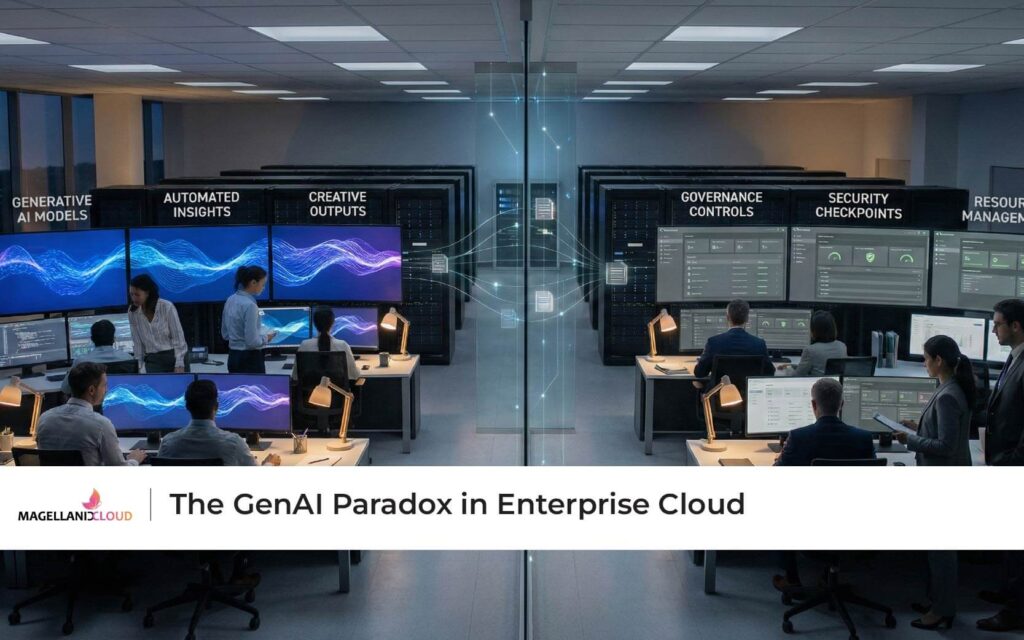
This tension sits at the heart of the GenAI paradox in enterprise cloud environments. On one hand, enterprises are accelerating digital transformation with AI-driven cloud infrastructure that promises scale, speed, and intelligence. On the other hand, the same systems are amplifying cost volatility, security exposure, and governance gaps at a pace most organizations were never prepared for.
So the real question isn’t whether enterprises should adopt Generative AI in the cloud. It’s whether they can do so without losing control of the very foundations their businesses depend on.
If GenAI Is So Powerful, Why Are Enterprises Rushing In Without a Map?
Why has Generative AI in enterprise cloud environments become nearly impossible to ignore? Because the productivity upside is undeniable.
Across industries, 24% of tasks can already be fully automated, and another 42% can be augmented by Generative AI. That’s not marginal efficiency—it’s a structural shift in how work gets done. From software development and customer support to data analysis and internal knowledge management, enterprise cloud transformation with AI is reshaping workflows faster than any previous wave of automation.
But here’s the paradox: if the opportunity is so clear, why does adoption feel so chaotic?
Enterprise GenAI adoption challenges rarely stem from the models themselves. They arise from speed. Cloud platforms make it easy to spin up AI services in minutes, but strategy, governance, and operational readiness move far more slowly. The result is rapid experimentation without guardrails—innovation sprinting ahead while control mechanisms jog behind.
Is it any surprise that this imbalance creates long-term risk?
When Productivity Becomes Invisible Risk
If GenAI is everywhere, why does it still feel invisible to leadership?
One uncomfortable reality is uncontrolled GenAI usage in enterprises. Tools adopted informally by employees often operate outside official IT visibility, creating a new form of shadow IT—what many now call shadow AI usage in organizations.
Consider this: 48% of employees admit to entering non-public or sensitive company information into GenAI tools. Not because they’re malicious—but because the tools are useful, accessible, and rarely accompanied by clear rules.
This is where enterprise AI cloud security risks quietly multiply. Sensitive data flows into prompts, outputs are reused across teams, and proprietary information is exposed in ways traditional security frameworks were never designed to monitor.
So the question becomes: how can organisations talk about innovation while ignoring the lack of governance in GenAI adoption happening right under their noses?
If Cloud Is Meant to Optimize Costs, Why Is AI Making It More Expensive?
Wasn’t cloud supposed to reduce infrastructure waste and improve financial predictability? Then why are cloud bills spiraling upward just as GenAI adoption accelerates?
Organizations are exceeding cloud budgets by an average of 17%, with cloud spend growing roughly 28% year over year—AI workloads being a key driver. This isn’t just inflation; it’s architectural complexity. Generative AI models demand persistent compute, high-performance GPUs, increased data movement, and continuous experimentation.
These are the hidden cloud costs of generative AI—costs that don’t always show up in initial projections. In many cases, teams underestimate why GenAI increases cloud spending: training cycles, inference at scale, duplicated workloads across departments, and underutilized resources left running “just in case.”
Traditional FinOps frameworks struggle to keep up, leading to growing FinOps challenges with AI workloads. When cost attribution becomes murky and ownership unclear, optimization turns reactive rather than strategic.
So the paradox deepens: AI is meant to drive efficiency, yet it often introduces financial opacity instead.
Governance After the Fact-Why Are Enterprises Pulling the Brakes Now?
If the risks are so obvious, why wasn’t governance built first?
In many enterprises, GenAI governance and compliance discussions only began after tools were already embedded in workflows. That delay has consequences. In response to mounting concerns, 27% of organizations temporarily banned Generative AI tools due to privacy and data-security risks.
This reactionary approach highlights a deeper issue: generative AI compliance issues in cloud environments are still poorly understood. Regulatory uncertainty, data residency requirements, and model accountability raise questions most organizations cannot yet answer with confidence.
Banning tools may reduce immediate exposure, but it also stalls innovation. The real challenge lies in balancing innovation and risk in enterprise AI—creating policies that enable progress without inviting operational chaos.
Is governance meant to block innovation, or should it be the framework that allows it to scale safely?
The Operational Reality No One Talks About
Beyond cost and compliance, what happens to day-to-day operations when GenAI becomes deeply embedded?
The operational risks of GenAI in enterprise IT are subtle but significant. AI-driven cloud infrastructure introduces dependencies that are harder to troubleshoot, failures that are less predictable, and outcomes that are sometimes opaque even to their creators.
When AI systems generate outputs that influence decisions, who owns accountability? When models behave unexpectedly, who intervenes? These questions expose the fragility beneath the promise of autonomy.
The risks of generative AI in cloud computing aren’t just technical they’re organizational. Without clear ownership models and escalation paths, enterprises risk building systems they can’t fully explain or control.
Conclusion: Is the GenAI Paradox a Problem or a Test of Enterprise Maturity?
So, where does this leave enterprises navigating the GenAI paradox in enterprise cloud environments?
The paradox isn’t a failure of technology. It’s a test of readiness. Generative AI amplifies whatever foundations already exist—strong governance becomes stronger, weak discipline becomes more visible, and unclear ownership turns into operational risk.
Enterprises that treat GenAI as “just another cloud service” will struggle. Those that recognize it as a strategic capability—requiring cost discipline, security design, and cultural alignment—will unlock its real value.
The question is no longer whether GenAI belongs in the enterprise cloud. It’s whether enterprises are willing to evolve fast enough to deserve it.
Future Outlook: Can Enterprises Resolve the Paradox Before It Defines Them?
Looking ahead, the future of enterprise cloud transformation with AI depends on intent. Organizations that invest early in GenAI governance and compliance, modern FinOps practices, and transparent usage policies will turn today’s paradox into tomorrow’s advantage.
The winners won’t be the ones who adopt GenAI first—but the ones who adopt it wisely. As regulations mature, tooling improves, and accountability models solidify, the GenAI paradox may fade into a defining chapter of digital evolution.
Until then, enterprises must keep asking the hardest question of all:
Are we building intelligence into our cloud—or building risk we don’t yet understand?