The AI Talent Shift: Why Companies Now Need AI Literacy More Than Coders
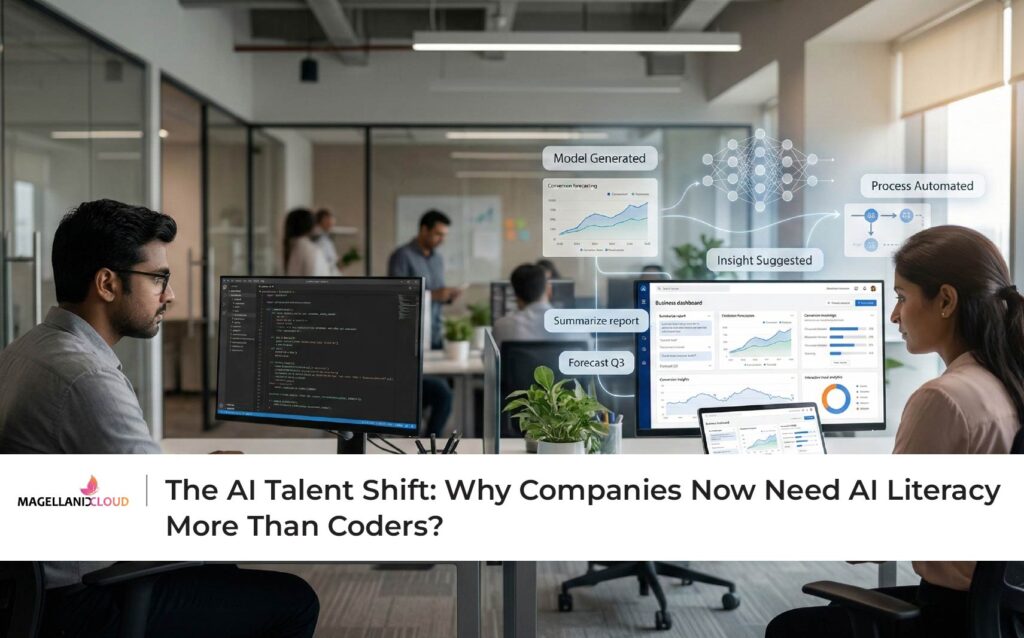
For decades, companies believed software talent shortages revolved around one problem: not enough coders. Job descriptions demanded mastery in programming languages. Hiring cycles prioritised syntax over strategy. Engineering teams grew larger to keep up with digital transformation mandates.
Then generative AI arrived.
Today, AI tools can generate code snippets in seconds, suggest architecture patterns, debug errors, and even build functional prototypes with minimal human input. The bottleneck has shifted. It is no longer about writing code. It is about understanding how to deploy AI responsibly, strategically, and at scale.
This is the AI talent shift.
From Coding Skills to AI Literacy
AI literacy goes beyond knowing how to use an AI tool. It includes understanding how AI systems are trained, how data influences outcomes, how bias can creep into algorithms, and how AI integrates into enterprise workflows.
According to World Economic Forum’s Future of Jobs Report, analytical thinking and AI-related competencies are among the fastest-growing skill demands globally. Employers increasingly prioritise cognitive skills, technology literacy, and systems thinking over narrow technical execution.
Similarly, LinkedIn’s Workplace Learning Report highlights AI literacy and data fluency as critical workforce priorities across industries.
The message is clear. Coding remains valuable, but the enterprise advantage now lies in professionals who understand AI’s broader implications.
AI Is Automating Coding, Not Strategy
Generative AI systems can accelerate development cycles dramatically. McKinsey & Company estimates that generative AI could add trillions of dollars in productivity gains globally, particularly in software engineering and customer operations.
However, AI tools still require human oversight. They do not understand business context inherently. They cannot independently align solutions with regulatory requirements or long-term enterprise strategy.
An AI system may generate code, but it cannot determine whether that system aligns with data privacy laws, ethical standards, or customer expectations. That responsibility rests with AI-literate professionals.
In other words, automation reduces the demand for repetitive coding. It increases the demand for AI governance, deployment strategy, data engineering, and ethical oversight.
The AI Skills Gap Is Expanding
The rapid acceleration of AI adoption has created a widening skills gap. Organisations want AI-powered transformation. Yet many lack employees who can critically evaluate AI models, interpret outputs, or integrate AI into operational systems.
IBM reports that business leaders globally identify lack of AI skills as one of the primary barriers to scaling AI initiatives.
In India, the demand is even sharper. With Digital India initiatives, fintech expansion, smart infrastructure projects, and enterprise cloud transformation underway, the need for AI-fluent professionals spans sectors from BFSI to manufacturing to public infrastructure.
This shift creates urgency for enterprises to rethink workforce strategies.
AI Literacy as a Strategic Competency
AI literacy is not confined to engineering teams. It must extend to product managers, compliance officers, HR leaders, policymakers, and executives.
An AI-literate workforce understands:
- How training data affects model behaviour.
- How to detect and mitigate algorithmic bias.
- How to ensure explainability and accountability.
- How to evaluate vendor AI solutions critically.
- How to integrate AI systems into secure cloud architectures.
According to Harvard Business Review, companies that combine technical AI expertise with domain knowledge outperform those relying solely on technical deployment.
AI literacy empowers enterprises to move from experimentation to scalable impact.
Workforce Transformation in the AI Era
The AI talent shift represents a broader workforce transformation. Instead of replacing jobs outright, AI reshapes them.
The World Economic Forum projects that while automation will displace certain tasks, it will simultaneously create new roles requiring analytical reasoning, AI supervision, and technology strategy.
Coding will not disappear. It will evolve. Developers will focus less on routine syntax and more on system architecture, model evaluation, and AI orchestration.
Enterprises must therefore invest not just in hiring, but in upskilling.
The Indian Context
India’s companies are navigating rapid digital expansion. From AI-powered surveillance systems and fintech platforms to cloud-native enterprise software, AI integration is accelerating across industries.
NITI Aayog’s National Strategy for Artificial Intelligence emphasises building a workforce equipped with AI capabilities to sustain national competitiveness.
This strategy aligns with enterprise needs. AI adoption without AI literacy risks inefficiency, compliance breaches, and ethical pitfalls.
India’s demographic advantage can translate into AI leadership, but only if talent transformation keeps pace with technological advancement.
The Role of IT Staffing in the AI Talent Shift
Traditional IT staffing models focused on supplying coding talent at scale. The AI era demands something more nuanced.
Enterprises now seek professionals who combine:
- AI and machine learning understanding.
- Cloud-native infrastructure knowledge
- Data governance expertise.
- Cybersecurity awareness.
- Regulatory compliance literacy.
The shift requires staffing partners who can identify, train, and deploy AI-fluent talent rather than simply fill programming vacancies.
How JNIT and Magellanic Cloud Enable AI-Ready Talent
At Magellanic Cloud Limited (MCL), we recognise that digital transformation succeeds only when supported by the right talent ecosystem.
Through JNIT, our IT staffing and talent solutions vertical, we align workforce strategy with AI-era enterprise demands.
Our approach includes:
- Identifying AI-literate professionals with cross-domain capabilities.
- Supporting enterprises in building AI-ready teams for cloud, data, and analytics projects.
- Facilitating upskilling initiatives aligned with emerging AI frameworks.
- Deploying talent that understands governance, compliance, and ethical AI practices.
- Integrating staffing strategy with broader digital transformation roadmaps across MCL’s group capabilities.
JNIT does not simply supply coders. We enable AI fluency within enterprise ecosystems.
By connecting organisations with talent equipped for AI-driven decision-making and deployment, we help bridge the gap between innovation ambition and operational reality.
Coding Is Still Important. But It Is Not Enough.
The narrative that AI will eliminate developers is misleading. Coding remains foundational. What has changed is its position within the enterprise value chain.
The highest leverage no longer lies in writing lines of code. It lies in orchestrating intelligent systems, ensuring compliance, embedding ethical safeguards, and aligning AI solutions with strategic goals.
Enterprises that recognise this shift early will gain competitive advantage.
Those that continue hiring exclusively for traditional coding roles may struggle to translate AI investment into impact.
Preparing for the Next Decade of Work
The AI talent shift is not a temporary trend. It is structural.
Generative AI will continue to automate routine development tasks. Cloud platforms will simplify deployment pipelines. Low-code and no-code environments will further democratise software creation.
What will remain scarce is judgment.
Judgment in selecting models.
Judgment in interpreting outputs.
Judgment in balancing innovation with governance.
Judgment in ensuring inclusion and fairness.
That judgment depends on AI literacy.
Enterprises that cultivate AI-literate workforces will not merely adapt to change. They will shape it.
Conclusion: From Coders to AI Architects
The question is no longer whether enterprises need coders. They do. The question is whether coders alone can carry digital transformation into the AI era.
They cannot.
The AI talent shift demands professionals who understand systems, ethics, governance, data, and deployment strategy.
At Magellanic Cloud, through JNIT, we believe the future of enterprise success lies in cultivating AI-ready talent ecosystems, individuals capable of navigating complexity, harnessing automation, and guiding innovation responsibly.
Coding built the digital age.
AI literacy will define the next one.