Skills Are the New Currency- Are You Investing Right?
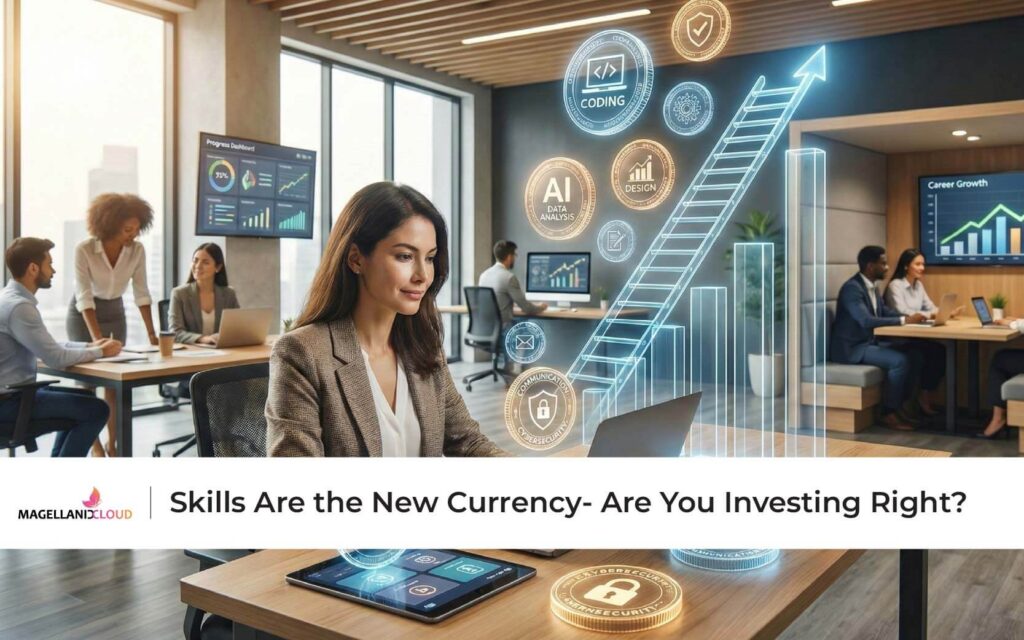
What if the most valuable asset on your balance sheet isn’t your technology stack, intellectual property, or market share but your people?
What if competitive advantage no longer comes from what your organization owns, but from what its workforce can do?
In a world shaped by automation, AI-driven operations, and constant disruption, this question is no longer philosophical. It’s strategic. As machines take over repetitive tasks and algorithms accelerate decision-making, businesses are discovering a powerful truth: skills-not roles are the real drivers of growth.
Welcome to the era where Human Capital Development defines who leads, who lags, and who becomes irrelevant.
The Shift from Headcount to Capability
For decades, businesses optimized for scale. More people meant more output. Standardized roles ensured predictability. Training was periodic, often reactive, and usually tied to immediate needs.
That model is breaking.
Automation has replaced routine work. AI has redefined analysis and forecasting. Digital platforms have collapsed geographical boundaries. Suddenly, productivity isn’t about how many employees you have—it’s about how adaptable, creative, and skilled they are.
Organizations that treat talent as a static resource struggle to keep up. Those that view skills as a dynamic investment outperform. This is why Human Capital Development has moved from HR agenda to boardroom priority.
Why Skills Are Now a Business Currency
Currencies hold value because they enable exchange, growth, and stability. Skills do the same—within and beyond organizations.
Skills unlock innovation: New capabilities lead to new products, services, and business models.
Skills fuel productivity: Skilled teams work faster, smarter, and with fewer errors.
Skills reduce risk: Adaptable talent helps organizations pivot when markets shift.
Skills attract opportunity: Companies known for learning cultures draw high-potential talent and partners.
In short, skills determine how effectively businesses convert strategy into execution.
The Data Behind the Skills Economy
This shift isn’t theoretical—it’s measurable.
Over 85% of global employers now consider skills-based hiring imperative, signaling a clear move away from credential-first talent models. At the same time, organizations are backing this shift with investment. The global corporate training market, valued at $361.5 billion in 2023, is projected to grow to $805.6 billion by 2035, expanding at a 7% CAGR between 2024 and 2035.
These numbers tell a simple story: businesses are reallocating capital toward learning, reskilling, and capability-building because that’s where future returns lie.
Automation Didn’t Kill Jobs-It Changed Them
A common misconception is that automation eliminates the need for human effort. In reality, it eliminates the need for certain skills while amplifying demand for others.
Tasks that are rule-based, repetitive, and predictable are increasingly automated. What remains—and grows in importance—are skills that machines struggle to replicate:
Critical thinking and problem-solving
Creativity and innovation
Emotional intelligence and collaboration
Strategic decision-making
Cross-functional and digital fluency
This evolution places Human Capital Development at the center of workforce strategy. It’s no longer about training employees for their current roles—it’s about preparing them for roles that don’t yet exist.
Continuous Learning Is No Longer Optional
In the past, learning followed a linear path: education → employment → incremental training. Today, that model is obsolete.
Skills have shorter shelf lives. Technologies evolve faster than job descriptions. Employees who stop learning fall behind—not in years, but in months.
Forward-looking organizations embed continuous learning into everyday work:
Learning platforms integrated into workflows
Microlearning instead of long, infrequent training programs
Internal mobility driven by skill readiness, not tenure
Data-driven insights to identify emerging skill gaps
This approach transforms learning from a cost center into a growth engine.
From Training Programs to Skills Acceleration
There’s a difference between offering training and accelerating skills.
Traditional training often focuses on completion: courses attended, hours logged, certifications earned. Skills acceleration focuses on outcomes: capabilities applied, problems solved, value created.
Modern talent strategies emphasize:
Speed: How quickly can employees acquire and apply new skills?
Relevance: Are skills aligned with future business priorities?
Transferability: Can skills move across roles, teams, and projects?
When skills acceleration becomes a strategic goal, learning directly impacts innovation cycles, time-to-market, and customer experience.
Human Capital as a Competitive Advantage
Technology is increasingly commoditized. Tools that once differentiated companies are now widely accessible. What separates leaders from followers is how effectively they deploy technology through people.
Organizations that prioritize skill development see tangible benefits:
Faster adoption of new technologies
Higher employee engagement and retention
Stronger internal leadership pipelines
Greater resilience during market disruptions
In this context, Human Capital Development isn’t just about employee growth—it’s about enterprise survival.
The Leadership Imperative
This transformation demands a shift in leadership mindset.
Leaders must move beyond viewing talent as an operational resource and start treating it as strategic capital. That means asking different questions:
What skills will our business need in three to five years?
Where are our most critical capability gaps today?
How do we measure skill impact, not just training activity?
Are we rewarding learning, adaptability, and innovation?
Answering these questions requires collaboration across HR, technology, and business leadership—and a willingness to invest ahead of certainty.
The Role of Culture in Skill Growth
Even the best learning platforms fail without the right culture.
Organizations that succeed in building future-ready talent share common cultural traits:
Psychological safety to experiment and fail
Recognition for learning, not just performance
Transparency around skill expectations and opportunities
Leadership participation in learning initiatives
When learning is normalized and encouraged, employees stop seeing upskilling as extra work and start seeing it as career insurance.
Skills, Strategy, and Digital Futures
As businesses pursue automation, AI, and digital innovation, the success of these initiatives ultimately depends on people. Technology may enable transformation, but skills determine whether transformation delivers value.
Companies that align workforce development with strategic goals create a powerful flywheel: skilled employees drive better outcomes, which fuel growth, which funds further investment in people.
Those that don’t risk owning advanced tools without the talent to use them effectively.
So, Are You Investing Right?
In today’s economy, skills are appreciating assets. They compound over time, unlock new opportunities, and protect against disruption. Ignoring them is no longer a neutral choice—it’s a strategic risk.
The question isn’t whether your organization invests in people.
The question is whether it’s investing in the right skills, at the right speed, with the right intent.
Because in the new currency of business, those who invest wisely don’t just survive—they lead.