Over 80% of Security Incidents Now Involve Video Data. Cameras Alone Won’t Save You.
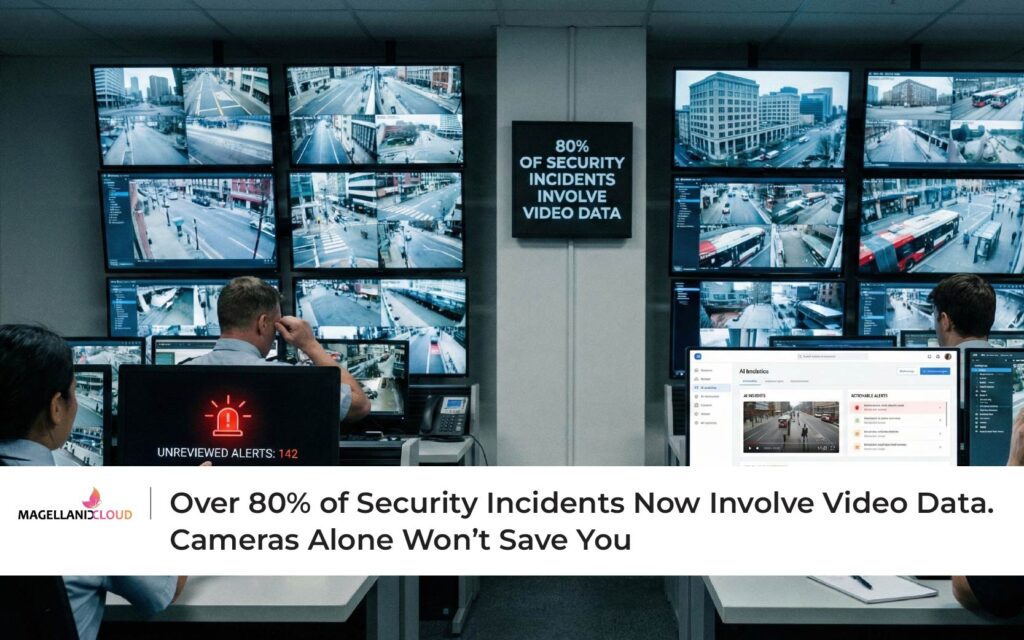
A security incident took place at a crowded metro station. Cameras capture every angle. Footage exists. Logs are preserved. Yet the response came late. The threat escalates before anyone intervenes. Later, investigators replay the video frame by frame and piece together what went wrong.
This scenario is increasingly common.
Modern organisations are surrounded by cameras, but still struggle with security outcomes. The reason is simple. Visibility without intelligence does not equal safety.
Recent studies show that over 80% of security incidents now involve video data at some stage, either for detection, investigation, or response. But video alone is no longer sufficient to prevent or mitigate incidents in real time.
Why Video Became Central to Security?
Video is the most information-dense security signal available today. It captures movement, behaviour, context, and environment in ways sensors or logs cannot.
According to Verizon’s Data Breach Investigations Report, physical intrusion, insider misuse, and surveillance-related failures increasingly intersect with digital security incidents. Video evidence often becomes the primary investigative asset after an event.
At the same time, cities, enterprises, banks, airports, and campuses have deployed millions of cameras. The assumption was straightforward: more cameras mean more security.
That assumption no longer holds.
The Scale Problem Cameras Created
Modern surveillance environments generate overwhelming volumes of video. A single city or enterprise command center may take in tens of thousands of camera feeds around the clock.
According to studies, video data is among the fastest-growing data types globally, driven by surveillance, smart infrastructure, and IoT adoption.
Human operators cannot watch everything. Fatigue, distraction, and delayed response are inevitable. As a result, many incidents are only discovered after damage occurs.
Cameras provide evidence. They do not provide judgment.
Why 80% of Incidents Touch Video Data
The reason video appears in such a high proportion of security incidents is not because cameras failed, but because they were passive observers.
In retail theft, cameras record suspicious behaviour but do not flag it in time. In critical infrastructure, cameras capture perimeter breaches but rely on manual monitoring. In corporate campuses, video exists but is reviewed only after an incident is reported.
Harvard Business Review notes that organisations often invest heavily in data collection but underinvest in systems that turn data into action.
Video data becomes central not because it prevents incidents, but because it explains them too late.
The Shift From Surveillance to Intelligence
This is where AI video analytics changes the equation.
AI-powered video systems do not just record. They interpret behaviour in real time. They detect anomalies, recognise patterns, and trigger alerts when predefined conditions are met. Surveillance experts describe intelligent video analytics as a key component of next-generation operational intelligence, especially in high-scale environments where human attention is limited.
Instead of asking humans to watch screens, AI watches continuously and calls attention only when something matters.
Why Cameras Alone Cannot Deliver Outcomes
Cameras answer one question well: What happened?
Security teams increasingly need answers to different questions:
- What is happening right now?
- What behaviour deviates from normal?
- What requires immediate response?
- What patterns indicate future risk?
Traditional CCTV systems are not designed for this. They rely on manual review and reactive workflows.
Gartner points out that organisations relying solely on camera infrastructure without analytics face diminishing returns on surveillance investments.
The intelligence layer, not the lens, determines effectiveness.
ICCCs and the New Surveillance Reality
Integrated Command and Control Centres (ICCCs) exemplify this shift. ICCCs aggregate video feeds, sensor data, traffic systems, and emergency inputs into a unified operational view.
However, early ICCC deployments often struggled because they centralised data without intelligence. Operators faced the same overload problem, just in a bigger room.
The next generation of ICCCs embeds AI video analytics to:
- auto-detect incidents
- classify severity
- prioritise response
- track resolution
According to the World Economic Forum, smart city command centers achieve meaningful impact only when analytics drive real-time decisions rather than post-event reviews.
Security Is Now a Behaviour Problem
Most modern security incidents are not obvious breaches. They involve subtle behavioural signals. Loitering. Unusual movement patterns. Restricted-area access. Timing anomalies.
AI video analytics excels at behavioural understanding. It learns what “normal” looks like and flags deviations instantly.
Accenture reports that AI-enabled surveillance systems significantly reduce response times by identifying risks before escalation.
This is especially critical in environments like:
- transport hubs
- banking facilities
- manufacturing plants
- data centers
- public spaces
Where seconds matter, cameras alone cannot keep up.
The Governance and Trust Question
As video analytics becomes more powerful, governance becomes essential. Organisations must balance security with privacy, compliance, and ethical use.
Experts emphasise that AI-driven surveillance must be transparent, explainable, and proportionate.
AI systems should flag events, not profile people indiscriminately. Human oversight must remain central. When designed responsibly, intelligent surveillance strengthens trust rather than undermines it.
India’s Context: Scale Demands Intelligence
India’s digital and physical infrastructure operates at massive scale. National highways, railways, airports, smart cities, banks, and campuses generate continuous video streams.
Manual monitoring does not scale. Reactive review does not protect.
NITI Aayog has highlighted the need for AI-driven monitoring and decision systems to support India’s urban and infrastructure growth responsibly.
AI video analytics is no longer optional. It is foundational.
Magellanic Cloud’s Role: From Cameras to Cognitive Surveillance
At Magellanic Cloud Limited (MCL), we see this challenge clearly. Organisations do not lack cameras. They lack situational intelligence.
Through Scanalitix, our flagship unified surveillance platform, MCL helps enterprises and public agencies evolve from passive CCTV to AI-driven, outcome-oriented surveillance systems.
Our work focuses on:
- real-time video analytics for anomaly and behaviour detection
- integration of video with command-center workflows
- AI-based alerting and prioritisation
- human-in-the-loop oversight for accountability
- scalable architectures aligned with ICCC environments
Magellanic’s approach ensures that video data does not sit idle, but actively contributes to prevention, response, and resilience.
The New Truth About Security
Security today is not about seeing more. It is about understanding faster.
Over 80% of incidents involve video data because video captures reality. But without intelligence, reality arrives too late.
Cameras will always matter. But cameras alone will never save you.
The future of security belongs to systems that can see, think, and act together.