India’s Infrastructure Is Getting Smarter: How AI Surveillance Is Rewriting Public Safety in 2026
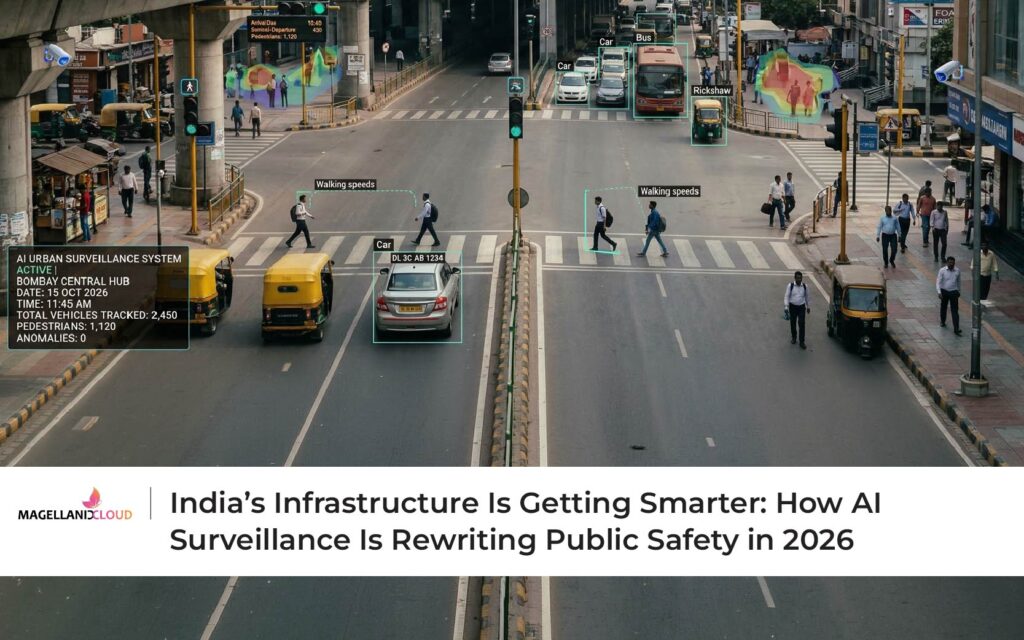
It is 8:45 a.m. at a busy urban intersection. Traffic builds rapidly as office commuters flood the roads. A pedestrian crosses unexpectedly. A vehicle slows abruptly. Within seconds, traffic signals adjust dynamically, an alert is triggered at a central command center, and a nearby patrol unit is notified.
No human operator pressed a button.
This is not a glimpse of the distant future. It is the new reality of India’s smart infrastructure in 2026, where AI surveillance and real-time analytics are transforming how cities monitor, respond, and ensure public safety.
India is no longer just installing cameras. It is building intelligent systems that can observe, interpret, and act.
The Shift from CCTV to Cognitive Surveillance
For years, surveillance in India relied heavily on CCTV cameras. These systems captured vast amounts of video data, but they operated passively. Footage was recorded, stored, and reviewed only after an incident occurred.
The limitation was clear. Cameras could see everything but understand nothing.
Today, that model is being replaced by AI-powered video analytics, where surveillance systems actively analyse live video feeds, detect anomalies, and trigger responses in real time.
According to Gartner, organisations are rapidly adopting AI-driven video analytics to move from reactive monitoring to proactive incident management.
This evolution marks the transition from surveillance infrastructure to cognitive infrastructure.
ICCCs: The Nerve Centres of Smart Cities
At the heart of this transformation are Integrated Command and Control Centres (ICCCs).
ICCCs serve as centralised hubs that aggregate data from multiple urban systems—traffic signals, CCTV cameras, emergency services, environmental sensors, and public utilities—into a unified platform.
Under India’s Smart Cities Mission, over 80 ICCCs have been deployed across cities, acting as 24/7 operational control rooms.
These centres are no longer just monitoring dashboards. With AI integration, they are evolving into decision-making engines.
AI systems within ICCCs can:
- detect traffic congestion patterns
- identify suspicious behaviour in public spaces
- monitor crowd density during events
- trigger automated alerts during emergencies
The result is faster response times and improved situational awareness.
Real-Time Incident Detection: The Game Changer
Public safety depends on how quickly incidents are detected and addressed. Traditional systems often relied on manual observation or delayed reporting.
AI surveillance changes this paradigm.
Modern video analytics systems can detect anomalies such as unattended objects, sudden crowd movement, perimeter breaches, or traffic violations within seconds. These systems analyse patterns, compare them against baseline behaviour, and generate alerts instantly.
According to IDC, real-time analytics is becoming critical for operational efficiency across urban infrastructure and public safety systems.
This capability transforms surveillance from passive recording into active prevention.
Railways and Highways: Infrastructure at Scale
India’s public safety challenge is amplified by scale. Indian Railways serves over 20 million passengers daily, while national highways span more than 140,000 kilometres.
Managing safety across such vast networks requires more than human oversight.
AI-powered surveillance systems are now being deployed across railway stations, tracks, and highways to monitor activity continuously. These systems detect crowd surges, unauthorised access, accidents, and unusual movement patterns in real time.
The Ministry of Road Transport and Highways has emphasised the role of Intelligent Transport Systems (ITS) and digital monitoring in improving road safety and traffic management.
Similarly, railway modernisation initiatives increasingly integrate AI-based surveillance to enhance passenger safety and operational efficiency.
This convergence of AI, infrastructure, and real-time monitoring is redefining how safety is managed across India’s critical networks.
AI Video Analytics: Understanding Behaviour, Not Just Events
One of the most significant advancements in surveillance is the shift from event detection to behavioural analysis.
AI systems can now identify patterns such as loitering, abnormal movement, crowd clustering, or suspicious trajectories. These behavioural indicators often precede incidents, enabling early intervention.
MIT Sloan Management Review highlights that AI-driven systems are increasingly capable of identifying patterns that humans may overlook, particularly in high-volume environments.
This capability allows authorities to act before situations escalate, improving both safety and efficiency.
Smart Infrastructure Needs Smart Data
India’s infrastructure is becoming increasingly digitised. Sensors, cameras, IoT devices, and connected systems generate enormous volumes of data every second.
However, data alone does not create intelligence.
The real value lies in integrating these data streams into unified platforms and applying AI models to extract actionable insights.
The World Economic Forum notes that smart infrastructure systems achieve impact only when data is integrated, analysed, and used for decision-making in real time.
This integration is what transforms cities from connected to intelligent.
Governance, Privacy, and Responsible Surveillance
As AI surveillance becomes more pervasive, concerns around privacy, governance, and ethical use of technology also grow.
Responsible deployment requires transparency, data protection, and clear accountability frameworks.
The OECD emphasises that AI systems must be designed with fairness, explainability, and human oversight to ensure trust.
India’s evolving data protection landscape further reinforces the need for secure and compliant surveillance systems.
Smart infrastructure must not only be intelligent but also trustworthy.
Magellanic Cloud’s Role: Building the Intelligence Layer
At Magellanic Cloud Limited, we see the transformation of infrastructure not as a hardware upgrade, but as an intelligence upgrade.
Through Scanalitix, our AI-powered surveillance and monitoring platform, we enable organisations and public authorities to move beyond traditional CCTV systems into integrated, AI-driven command ecosystems.
Scanalitix brings together video management, analytics, incident workflows, and field operations into a unified platform. It processes live video feeds, detects anomalies using AI models, and triggers actionable alerts in real time.
Our systems are designed to scale across multiple environments, urban command centers, railway networks, highways, and enterprise campuses while maintaining high availability and operational reliability.
By integrating AI video analytics with decision workflows, Scanalitix transforms surveillance into situational intelligence.
Magellanic Cloud’s broader capabilities in cloud infrastructure, data engineering, and AI further strengthen this ecosystem, enabling end-to-end digital transformation across smart infrastructure projects.
The Road Ahead: From Smart Cities to Cognitive Cities
India’s smart city journey is evolving. The next phase is not just about connectivity or digitisation. It is about cognition.
Cities will increasingly rely on systems that can:
- learn from data
- adapt to changing conditions
- predict risks before they occur
- respond autonomously when required
AI surveillance will play a central role in this transformation, acting as the sensory and analytical backbone of urban systems.
As infrastructure becomes smarter, public safety becomes more proactive, responsive, and resilient.
Conclusion: Intelligence Is the New Infrastructure
India’s infrastructure is no longer defined solely by roads, rails, or buildings. It is defined by the intelligence embedded within them.
From ICCCs to AI-powered surveillance systems, the country is building a digital nervous system capable of sensing, analysing, and responding in real time.
The transition from CCTV to cognitive command centers marks a fundamental shift in how public safety is managed.
And at the centre of this transformation lies a simple truth:
Seeing is no longer enough. Understanding is everything.