How AI Video Analytics is Driving Real-Time Intelligence in 2026
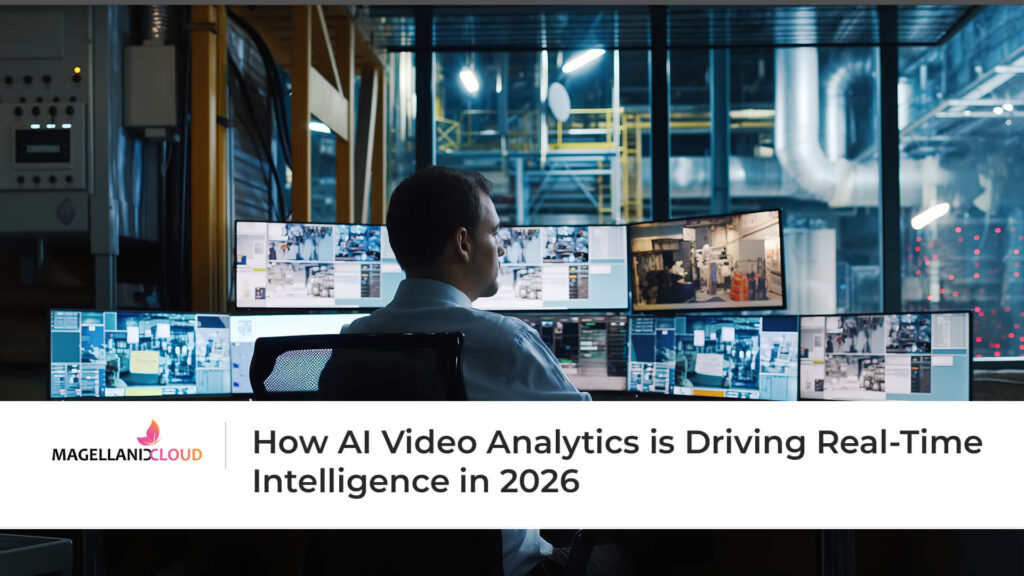
Are We Finally Moving from “Watching Footage” to “Understanding Reality in Real Time”?
What if your surveillance system didn’t just record incidents but predicted them before they happened? What if retail stores could instantly detect buying intent, or cities could respond to congestion before it builds?
This is not a futuristic scenario anymore. In 2026, AI video analytics is redefining how enterprises interpret the physical world, transforming passive video streams into real-time intelligence engines.
The shift is profound: from recording events to interpreting behavior, from manual monitoring to autonomous decision-making.
What is AI Video Analytics?
AI video analytics refers to the use of artificial intelligence, particularly computer vision and deep learning, to analyze video streams in real time. Unlike traditional CCTV systems that require human monitoring, AI-enabled systems can:
- Detect anomalies instantly
- Recognize objects, faces, and patterns
- Track behavior across multiple frames
- Trigger automated responses
This evolution is powered by advancements in edge computing, neural networks, and high-performance GPUs, enabling decisions to happen within milliseconds.
Why 2026 is the Inflection Point
The acceleration of AI video analytics isn’t incremental-it’s exponential.
- The global AI video analytics market is expected to reach USD 6.19 billion in 2026, growing rapidly toward USD 17.23 billion by 2031.
- Another estimate suggests the market could grow from USD 8.30 billion in 2025 to USD 64.48 billion by 2035, reflecting massive enterprise adoption.
These numbers highlight a critical shift: AI video analytics is no longer a niche security tool—it is becoming a core enterprise intelligence layer.
From Surveillance to Real-Time Intelligence
- Instant Threat Detection and Response
Traditional surveillance systems are reactive. AI-powered systems are proactive.
Modern AI video analytics can:
- Detect suspicious behavior (loitering, intrusion)
- Identify unattended objects
- Trigger alerts in real time
For example, smart city deployments now use AI cameras to detect fires, waterlogging, or accidents instantly—enabling faster emergency response.
Impact: Reduced response times, improved public safety, and lower operational risk.
3.BehaviorAnalytics: Understanding Human Intent
AI doesn’t just see—it interprets.
By analyzing movement patterns, dwell time, and interactions, AI video analytics can:
- Identify customer intent in retail environments
- Detect workforce inefficiencies in industrial settings
- Monitor crowd behavior in public spaces
This shift from “what happened” to “why it happened” is unlocking a new layer of actionable intelligence.
3.Edge AI: Intelligence at the Source
One of the biggest enablers in 2026 is edge computing.
Instead of sending video data to centralized cloud servers, AI models now run directly on cameras or local devices. This allows:
- Ultra-low latency decision-making
- Reduced bandwidth costs
- Enhanced data privacy
Edge AI is particularly critical for industries like manufacturing, transportation, and defense-where milliseconds matter.
- Multi-Camera Intelligence and Context Awareness
Modern systems don’t operate in silos anymore.
AI video analytics platforms can:
- Correlate data across multiple cameras
- Track objects across different locations
- Build contextual awareness of environments
For example, in transportation systems, AI can track a vehicle across multiple intersections and predict congestion patterns in real time.
Industry Use Cases: Where Real-Time Intelligence is Delivering Value
Smart Cities
Cities are becoming living, breathing data ecosystems.
AI video analytics is enabling:
- Traffic flow optimization
- Incident detection
- Crowd management during events
Municipalities are deploying AI-enabled cameras to transform urban governance into a proactive system.
Retail and Consumer Experience
Retailers are using AI video analytics to bridge the gap between physical and digital experiences.
Applications include:
- Customer journey tracking
- Heatmap analysis of store layouts
- Queue management
The result? Higher conversions, optimized store design, and personalized in-store experiences.
Manufacturing and Industrial Operations
In industrial environments, AI video analytics is enhancing operational efficiency by:
- Monitoring assembly lines
- Detecting safety violations
- Predicting equipment failures
This leads to reduced downtime, improved compliance, and increased productivity.
Banking and Financial Services
Banks are leveraging AI video analytics for:
- Fraud detection
- ATM surveillance
- Customer behavior insights
Real-time alerts ensure quicker response to suspicious activities, minimizing financial risks.
The Technology Behind the Transformation
Computer Vision + Deep Learning
At the core of AI video analytics lies computer vision, trained on massive datasets to recognize objects, faces, and patterns with high accuracy.
Video Language Models (VLMs)
Emerging in 2026, VLMs allow systems to:
- Understand video context
- Answer complex queries about footage
- Generate insights beyond predefined rules
This moves analytics from rule-based systems to context-aware intelligence.
Integration with IoT and Data Platforms
AI video analytics doesn’t operate in isolation. It integrates with:
- IoT sensors
- Enterprise data platforms
- AI/ML pipelines
This convergence enables a unified view of operations, combining visual data with other data streams.
Challenges Slowing Down Adoption
With increasing surveillance comes increased scrutiny. Regulations are pushing organizations to:
- Anonymize data
- Ensure ethical AI usage
- Maintain transparency
Integration Complexity
Deploying AI video analytics across legacy systems requires:
- Infrastructure upgrades
- Skilled resources
- Seamless integration with existing workflows
False Positives and Model Bias
AI systems are only as good as the data they are trained on. Bias and inaccuracies can lead to:
- Incorrect alerts
- Operational inefficiencies
The Business Impact: Why Enterprises Can’t Ignore It
AI video analytics is no longer just a technology upgrade-it’s a strategic necessity.
Organizations leveraging real-time video intelligence are seeing:
- Faster decision-making
- Improved operational efficiency
- Enhanced customer experiences
- Reduced risk and cost
In a world driven by instant insights, delayed decisions are becoming a competitive disadvantage.
The Future: From Insights to Autonomous Actions
The next phase of AI video analytics is already unfolding.
We are moving toward systems that:
- Not only detect but decide
- Not only alert but act
- Not only analyze but predict
Imagine a system that automatically reroutes traffic, adjusts store layouts dynamically, or shuts down machinery before failure, all without human intervention.
That’s where Video analytics is heading: from intelligence to autonomy.
Final Thoughts
So, are we still just watching video feeds or are we finally understanding them?
In 2026, AI video analytics is transforming video from a passive data source into a real-time intelligence powerhouse. Enterprises that embrace this shift are not just improving operations; they are redefining how decisions are made in the physical world.
The question is no longer whether to adopt AI video analytics.
It’s how fast you can integrate it into your decision-making fabric.