Choosing the Right Cloud Operating Model for Your Enterprise
Is Your Cloud Strategy Built to Scale or Just to Survive?
Are you moving to the cloud, or are you truly operating in it?
Many enterprises believe cloud adoption alone guarantees agility, resilience, and innovation. But the real differentiator lies deeper in the Cloud Operating Model that governs how technology, teams, processes, and governance align to deliver value.
Today, 94% of enterprises use cloud services in some form, proving that cloud is no longer experimental; it’s foundational. Yet adoption alone does not equal optimization. Without the right operating structure, organizations risk fragmented governance, uncontrolled costs, and underutilized capabilities.
So, how do you move beyond migration and truly master Choosing the Right Cloud Operating Model for your enterprise? Let’s break it down.
What Is a Cloud Operating Model?
A Cloud Operating Model defines how your organization designs, governs, manages, and optimizes cloud environments. It is not just about infrastructure; it’s about:
- Decision-making frameworks
- Role definitions and accountability
- Governance policies
- Security and compliance protocols
- Financial management structures
- DevOps workflows
In simple terms, it translates your Enterprise Cloud Strategy into execution.
Without it, cloud initiatives remain tactical. With it, they become transformational.
Why Choosing the Right Cloud Operating Model Matters
Cloud transformation is no longer optional. It is a business strategy driver.
Enterprises today are:
- Launching digital products faster
- Managing distributed workforces
- Scaling across global markets
- Integrating AI and automation
- Handling exponential data growth
Yet, the complexity of managing hybrid and distributed environments is increasing rapidly. In fact, 92% of businesses have adopted hybrid or multi-cloud environments, making governance and coordination more challenging than ever.
A structured Hybrid Cloud Operating Model or Multi-Cloud Strategy ensures that innovation does not outpace control.
Aligning Cloud Operating Model with Enterprise Cloud Strategy
Your Enterprise Cloud Strategy should define:
- Business objectives
- Risk appetite
- Innovation priorities
- Cost expectations
- Compliance requirements
The operating model must then operationalize this strategy across technology and teams.
For example:
- If speed to market is a priority, DevOps automation becomes central.
- If regulatory compliance is critical, a strong Cloud Governance Model must be embedded from day one.
- If cost efficiency is key, FinOps practices and cloud cost optimization frameworks must be integrated.
The operating model is the bridge between strategic intent and operational execution.
Public vs Private Cloud: The Foundational Decision
One of the earliest decisions in cloud architecture revolves around Public vs private cloud deployment.
Public Cloud
- Scalable and elastic
- Lower upfront capital expenditure
- Managed infrastructure
- Faster deployment
Private Cloud
- Greater control
- Custom security configurations
- Compliance-driven workloads
- Dedicated environments
However, most enterprises do not choose one exclusively. Instead, they operate within hybrid or multi-cloud ecosystems.
Enterprises today run 50% of their workloads in public cloud environments, reflecting a shift toward scalability and elasticity but not full dependence. Sensitive or mission-critical workloads often remain in private or hybrid environments.
This reality makes Choosing the Right Cloud Operating Model even more crucial, as governance must span multiple platforms seamlessly.
The Rise of Hybrid and Multi-Cloud Strategy
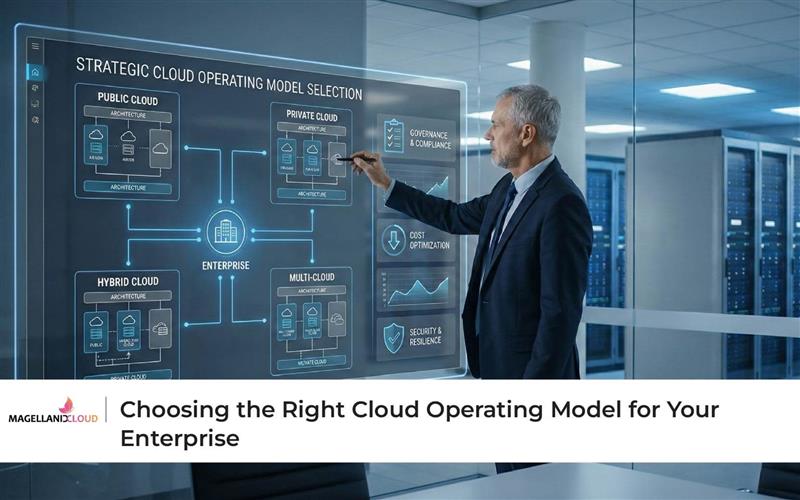
A Hybrid Cloud Operating Model combines public and private cloud infrastructures. Meanwhile, a Multi-Cloud Strategy involves using multiple public cloud providers.
Benefits include:
- Vendor flexibility
- Reduced dependency risks
- Geographic redundancy
- Optimized workload placement
Regulatory adaptability
But with flexibility comes complexity:
- Cross-platform visibility challenges
- Inconsistent security controls
- Data portability issues
- Cost tracking difficulties
This is where a well-defined Cloud Governance Model becomes essential.
Designing a Strong Cloud Governance Model
A mature Cloud Governance Model ensures that policies, standards, and controls are enforced across all environments.
Core components include:
- Identity and Access Management:Centralized authentication systems and role-based access control.
- Security and Compliance:Implementation of a robustCloud security framework covering encryption, monitoring, and threat detection.
- Financial Governance:Cloud cost optimization practices, including tagging, budget alerts, and usage analytics.
- Operational Standards:Standardized deployment templates and automation policies.Without governance, cloud environments can quickly spiral into uncontrolled sprawl.
Cloud Infrastructure Management in Complex Environments
Effective Cloud infrastructure management requires visibility and automation.
Key pillars include:
- Real-time monitoring
- Performance optimization
- Automated provisioning
- Infrastructure as Code (IaC)
- Disaster recovery planning
Managing distributed infrastructure manually is unsustainable. Automation and orchestration tools must be embedded into the operating model.
DevOps in Cloud Environments: The Agility Engine
No modern Cloud Operating Model is complete without integrating DevOps in cloud environments.
DevOps enables:
- Continuous Integration/Continuous Deployment (CI/CD)
- Faster release cycles
- Automated testing
- Cross-team collaboration
- Infrastructure consistency
When DevOps is embedded into the operating framework, the cloud becomes a platform for innovation rather than just infrastructure hosting.
Cloud Cost Optimization: A Strategic Imperative
Cloud provides scalability, but without discipline, it can also increase operational costs.
Cloud cost optimization strategies include:
- Rightsizing workloads
- Reserved instance planning
- Usage monitoring
- Eliminating idle resources
- Automating shutdown schedules
Financial governance must be proactive, not reactive.
As global technology investment accelerates, financial discipline becomes even more critical. According to the latest forecast by Gartner, worldwide IT spending is expected to total USD 5.74 trillion in 2025, an increase of 9.3% from 2024. This growth underscores how cloud investments are expanding and why enterprises must ensure ROI through a structured operating model.
Common Pitfalls in Choosing the Right Cloud Operating Model
Even well-intentioned organizations encounter challenges:
- Fragmented Ownership: Lack of clear accountability leads to inefficiencies.
- Shadow IT: Uncontrolled deployments increase risk.
- Security Gaps: Inconsistent policies across cloud providers expose vulnerabilities.
- Cultural Resistance: Teams accustomed to traditional IT may resist automation and decentralization.
A phased rollout, leadership alignment, and training programs help mitigate these risk
Key Steps to Choosing the Right Cloud Operating Model
- Assess Current State: Evaluate infrastructure maturity, workloads, and compliance requirements.
- Define Operating Principles: Clarify governance, security, and cost management priorities.
- Design Role Structures: Establish Cloud Center of Excellence (CCoE) or centralized governance teams.
- Standardize Deployment Frameworks: Use Infrastructure as Code and automation templates.
- Embed DevOps and Automation: Ensure agility and repeatability across environments.
- Continuously Optimize: Regularly review cost, performance, and security metrics.
Measuring Success in Your Cloud Operating Model
Success indicators include:
- Reduced deployment time
- Lower infrastructure costs
- Improved compliance posture
- Faster innovation cycles
- Enhanced system reliability
Metrics-driven governance ensures continuous improvement.
Future Outlook: From Adoption to Optimization
Cloud maturity is entering its next phase. The question is no longer whether enterprises will adopt cloud; it’s how effectively they will operate within it.
Future trends shaping the Cloud Operating Model include:
- AI-driven cloud optimization
- Automated governance frameworks
- Zero-trust security architectures
- Greater integration between FinOps and DevOps
- Policy-as-Code enforcement
As enterprises scale their digital ecosystems, operating discipline will define competitive advantage.
Choosing the right cloud operating model today determines whether your cloud journey becomes a cost center or a catalyst for transformation.
The cloud is already here.
The real decision is how intelligently you operate within it.