Can AI and Humans Design the Future Together?
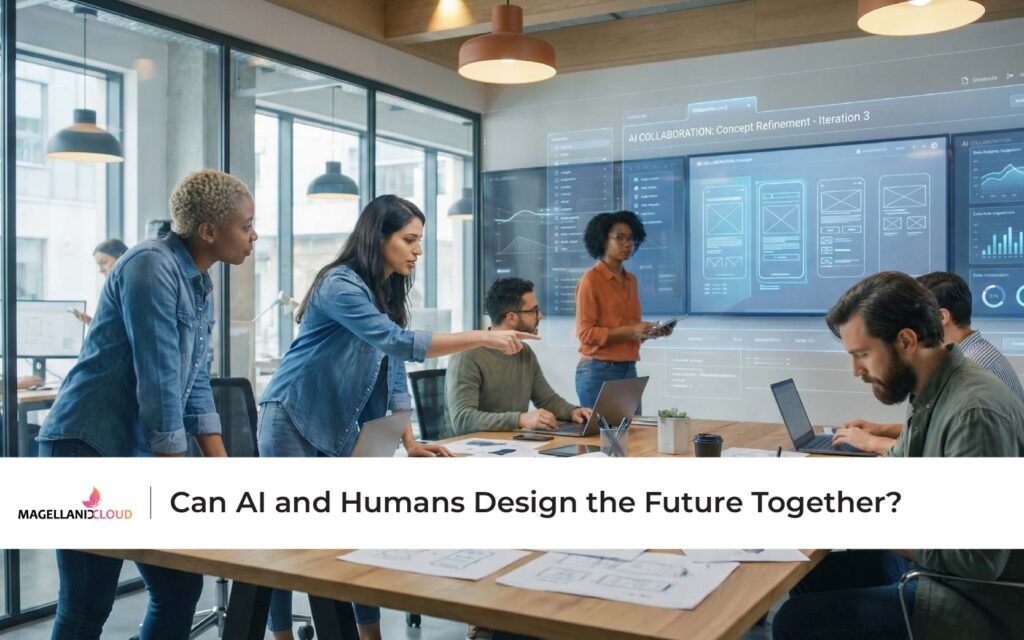
Imagine This: What will the first Design Review meeting led by an Algorithm be like?
The room is quiet. Not tense, just focused. On the wall-sized screen, a product roadmap is shown. Not as bullet points, but as scenarios.
“If we prioritise feature A, customer churn rate drops by 7% but operational costs rise,” the system says.
“If we delay expansion by one Quarter and reallocate resources here, long-term margins improve.”
No one interrupts. The leadership team leans forward. Someone finally asks, “What if regulation tightens in Q2?”
The system adjusts instantly. New paths appear.
This is not a future lab experiment. Versions of this are already happening inside progressive enterprises.
AI is not limited to execution or automation. It is entering spaces once reserved for design, strategy, and judgment. Yet the most important thing happening here is not that AI is speaking. It is that humans are still deciding.
Which brings us to the real question enterprises must answer today: Can AI and humans design the future together, without one overpowering the other?
Moving Beyond the False Choice of “AI vs Humans”
Much of the public conversation around AI has framed it as a replacement threat. Jobs versus machines. Creativity versus code. Control versus automation.
This framing misses the point.
According to the World Economic Forum’s Future of Jobs report, while AI will disrupt roles, it will also create millions of new ones that explicitly require human–AI collaboration, not separation. McKinsey’s research reinforces this: fewer than 5% of jobs can be fully automated, but nearly all jobs will change.
The real shift underway is not substitution. It is co-design.
Enterprises are discovering that AI is most powerful when it works with humans, not instead of them. Machines excel at scale, speed, and pattern recognition. Humans excel at context, values, trade-offs, and responsibility.
The future will not be designed by either alone. It will be designed at the intersection.
What AI Brings to the Design Table?
AI systems today can process volumes of information that no human team could realistically handle. They can simulate outcomes, detect hidden patterns, and surface options that would otherwise remain invisible.
In design and strategy contexts, AI contributes in several key ways:
- First, speed of synthesis. AI can ingest market data, operational metrics, customer behaviour, regulatory updates, and competitive signals simultaneously, then compress weeks of analysis into minutes.
- Second, scenario exploration. AI models can test hundreds of “what if” paths in parallel. What if demand shifts. What if costs spike. What if competitors move first.
- Third, objectivity at scale. AI does not get attached to legacy ideas. It highlights counterintuitive paths that humans might dismiss due to bias or familiarity.
But this power comes with limits.
AI does not understand intent. It does not grasp organisational culture. It does not weigh ethical implications instinctively. It does not feel reputational risk, employee morale, or long-term trust.
That is where humans remain essential.
What Humans Bring That AI Cannot Replace?
Human decision-making is not just logical. It is contextual, emotional, and value-driven.
Leaders understand nuance. They know when data tells only part of the story. They recognise when a “correct” decision might still be wrong for the organisation at that moment.
Humans bring:
- ethical judgment
- accountability
- domain intuition
- long-term vision
- empathy and social understanding
AI can recommend. Humans must own the outcome.
This is why the most effective enterprises are not automating decisions blindly. They are designing human-in-the-loop systems, where AI augments thinking but does not replace responsibility.
The future belongs to organisations that deliberately architect this balance.
India’s Moment: Designing Collaboration at Scale
India is uniquely positioned in this transition. The country operates some of the world’s largest digital systems, from payments and identity to logistics and governance. These systems succeed because they blend automation with oversight.
As Digital India evolves, enterprises will need to embed AI deeper into operations, planning, and governance. But scale amplifies risk. Poorly designed AI systems at scale can magnify bias, errors, and blind spots.
This makes design discipline critical.
Indian enterprises will increasingly demand partners who understand how to build AI systems that respect regulatory constraints, cultural realities, and organisational complexity, while still delivering speed and intelligence.
This is where transformation-focused AI engineering becomes essential.
Designing the Future Is a Systems Problem
Designing the future is not about deploying a model. It is about building systems of intelligence.
These systems include:
- data pipelines that ensure quality and integrity
- cloud architectures that scale securely
- AI models that explain their outputs
- governance layers that define boundaries
- workflows that keep humans in control
Without this system view, AI becomes brittle. With it, AI becomes a powerful collaborator.
This is the design philosophy that organisations must adopt if they want AI to enhance, not destabilise, their future.
How Motivity Labs Enables Human–AI Co-Design?
Motivity Labs, part of Magellanic Cloud, operates precisely at this intersection of AI engineering, cloud platforms, and enterprise transformation.
Rather than treating AI as a standalone tool, Motivity Labs focuses on embedding intelligence into business systems in a way that complements human decision-making.
AI Engineering With Humans in the Loop – Motivity designs AI systems where recommendations remain explainable, adjustable, and auditable. Human users can interrogate outputs, understand assumptions, and override decisions when context demands it.
This builds trust. It also ensures accountability remains where it belongs.
Cloud and Data Foundations That Support Collaboration – AI cannot collaborate if the underlying data is fragmented or unreliable. Motivity Labs builds cloud-native data architectures and secure pipelines that ensure AI systems work with clean, governed, and compliant data.
This backbone is critical for scaling AI responsibly across large enterprises.
Decision Support, Not Decision Replacement – Whether in operations, risk management, or strategic planning, Motivity’s solutions focus on decision support. AI surfaces options, insights, and trade-offs. Humans decide the path forward.
This approach avoids over-automation while still capturing AI’s analytical power.
Governance by Design – Motivity helps organisations embed governance, explainability, and auditability into AI systems from day one. This is especially critical in regulated industries and large enterprises where oversight cannot be an afterthought.
Where Enterprises Are Applying Collaborative Intelligence Today
Across industries, human–AI collaboration is already reshaping how organisations work.
Leadership teams use AI-driven dashboards to explore strategic options faster. Operations teams rely on predictive insights while retaining final control. Product teams test designs and market responses using AI simulations before committing resources.
In each case, AI expands the decision space. Humans choose within it.
This model reduces blind spots, shortens cycles, and improves outcomes without surrendering control.
The Risks of Getting Collaboration Wrong
Collaboration is not automatic. Poorly designed systems can create friction instead of value.
Over-automation can deskill teams. Opaque models can erode trust. Lack of governance can expose organisations to regulatory and reputational risk.
That is why designing collaboration requires intent, not optimism.
Enterprises must ask:
- Where should AI advise versus decide?
- How do humans challenge AI outputs?
- Who owns outcomes when AI is involved?
- How are values encoded into objectives?
These are design questions, not technical ones.
So, Can AI and Humans Design the Future Together?
Yes. But only if we design it deliberately.
The future will not be built by algorithms alone. Nor will it be built by intuition isolated from data. It will be built by organisations that understand how to combine machine intelligence with human judgment.
Motivity Labs exists to enable that combination. By engineering AI systems that respect human roles, strengthen decision-making, and scale responsibly, it helps enterprises participate in India’s digital push without losing control, trust, or purpose.
The most successful organisations of the next decade will not ask whether AI should lead or follow. They will ask how intelligently they can design the partnership.
The future is not human or machine.
It is human with a machine.
And it is being designed now.