AI Surveillance Systems: How Smart Surveillance 2.0 Is Transforming Real-Time Threat Detection
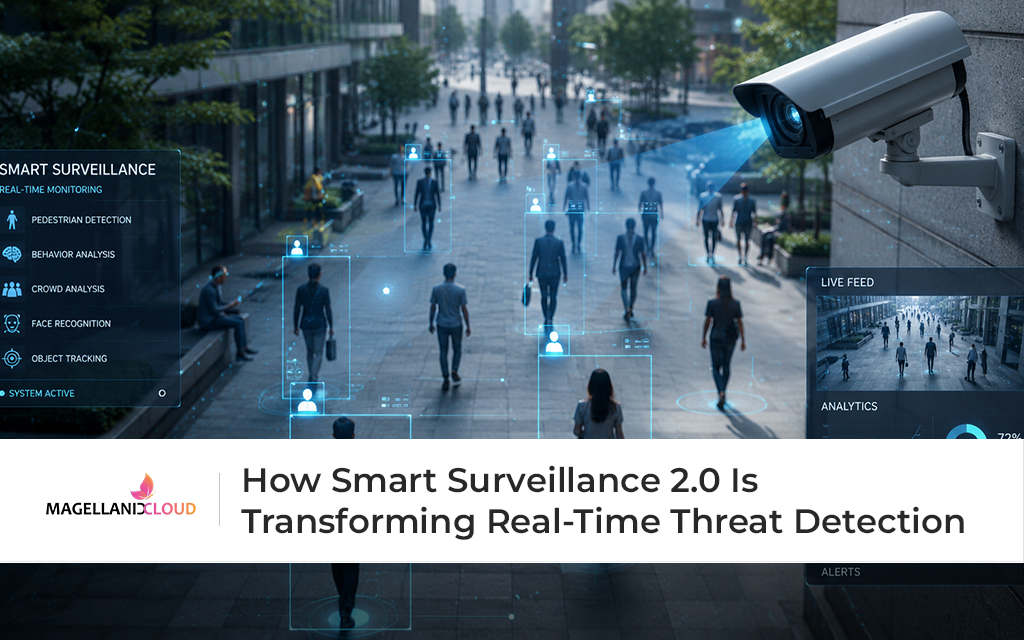
Every day, millions of cameras quietly record what happens around us. They monitor airports, metro stations, highways, factories, hospitals, corporate campuses, and public spaces. Yet despite this ever-expanding network of cameras, security teams continue to face a familiar challenge. Incidents are often detected only after they have occurred, forcing investigators to spend hours reviewing footage to reconstruct events.
This is precisely why AI surveillance systems are becoming the cornerstone of modern security operations.
Unlike conventional surveillance that simply captures video, AI surveillance systems analyse live footage, identify unusual behaviour, recognise potential threats, and generate actionable alerts within seconds. By combining artificial intelligence, computer vision, edge computing, and real-time analytics, organisations are transforming surveillance from a passive recording tool into an intelligent decision-support system.
As security risks become more sophisticated and infrastructure grows increasingly connected, the next generation of AI surveillance is being driven by intelligent cameras, automated workflows, and aerial monitoring through drones. Together, they are redefining how governments, enterprises, and critical infrastructure operators detect threats before they escalate.
Why Traditional Surveillance Systems Can No Longer Keep Pace
For decades, the purpose of a surveillance system remained largely unchanged. Cameras recorded events, stored footage, and provided evidence after an incident occurred. While this approach strengthened investigations, it depended almost entirely on human operators to monitor countless video feeds in real time.
The limitations of this model have become increasingly apparent.
A large airport or smart city may operate thousands of cameras simultaneously. Expecting security personnel to identify every suspicious movement across multiple screens is both unrealistic and inefficient. Human attention naturally declines over prolonged monitoring periods, increasing the risk of missed incidents.
According to the National Institute of Standards and Technology (NIST), sustained monitoring of multiple video streams significantly reduces an operator’s ability to detect critical events over time. As surveillance networks continue expanding, organisations need technology that can analyse video continuously without fatigue.
This growing demand has accelerated the adoption of AI surveillance systems, enabling cameras to move beyond observation and become intelligent security assets.
AI Surveillance Systems Are Teaching Cameras to Think
At the heart of modern surveillance lies artificial intelligence.
An AI surveillance system does far more than record activity. Using computer vision, deep learning, and behavioural analytics, it continuously interprets live video feeds to distinguish routine activity from genuine security risks.
Rather than waiting for someone to notice suspicious behaviour, the system can automatically detect abandoned objects, perimeter breaches, crowd formation, unauthorised access, loitering, unusual vehicle movement, or safety violations in real time.
An AI camera understands context instead of simply capturing images.
For example, a person walking through a restricted zone during authorised hours may not trigger an alert. The same activity late at night or after repeated attempts to access sensitive areas may immediately notify security teams.
This contextual awareness allows organisations to reduce false alarms while improving response times.
According to Gartner, AI-powered video analytics has evolved well beyond motion detection, enabling organisations to implement behaviour-based monitoring that significantly improves operational awareness and risk management.
The result is a surveillance ecosystem capable of recognising situations rather than merely recording them.
Video Surveillance Systems Are Becoming Intelligent Decision Platforms
The role of modern video surveillance systems has expanded far beyond physical security.
Today’s intelligent platforms combine video analytics with sensors, access control, incident management software, geospatial information, and enterprise dashboards to deliver a complete operational picture.
A modern video surveillance system is capable of analysing thousands of events simultaneously while prioritising those requiring immediate attention.
Imagine a manufacturing facility where an employee enters a hazardous area without protective equipment.
Rather than simply recording the incident, the system can instantly detect the safety violation, notify supervisors, trigger emergency protocols, and archive evidence for compliance reporting.
Similarly, in transportation hubs, video surveillance systems can identify overcrowding, detect suspicious packages, monitor traffic flow, and assist emergency responders before situations escalate.
This evolution is changing surveillance from a reactive security function into a proactive operational intelligence platform.
AI Surveillance Is Transforming Every Industry
The adoption of AI surveillance is no longer limited to law enforcement or critical infrastructure.
Manufacturing companies use intelligent surveillance to improve workplace safety, monitor production efficiency, and detect equipment anomalies.
Hospitals deploy AI-enabled monitoring to secure restricted areas, manage patient safety, and improve emergency response.
Retail businesses analyse customer movement while simultaneously identifying theft and suspicious behaviour.
Airports and railway stations rely on AI-powered surveillance to monitor passenger flow, enhance security screening, and optimise crowd management.
Smart cities integrate surveillance with traffic management systems, environmental sensors, and emergency response centres to improve urban operations.
According to MarketsandMarkets, the global video surveillance market continues to experience strong growth as organisations increasingly adopt artificial intelligence, cloud computing, and edge analytics to strengthen both security and operational efficiency.
The technology is no longer viewed solely as a protective measure. It has become an essential component of digital transformation.
From Video Surveillance Systems to Predictive Security
Traditional surveillance answered one question: “What happened?”
Modern AI surveillance systems answer three.
- What is happening?
- Why is it happening?
- What is likely to happen next?
By continuously analysing behavioural patterns and historical trends, artificial intelligence can identify subtle warning signs that often precede security incidents.
An individual repeatedly loitering near a restricted facility.
A vehicle parked unusually close to sensitive infrastructure.
An unexpected crowd gathering in an evacuation zone.
Individually, these events may appear insignificant. Collectively, they create behavioural patterns that intelligent systems recognise almost instantly.
This ability to detect risks before they become incidents represents one of the biggest advances in modern security.
Instead of simply collecting evidence after an event, organisations can intervene early and prevent disruption altogether.
Drones and AI Surveillance Are Creating a Unified Security Ecosystem
The true power of intelligent surveillance lies in combining technologies rather than deploying them in isolation.
Imagine an AI surveillance system installed across a logistics hub detecting an unauthorised vehicle entering a restricted zone. Instead of merely triggering an alarm, the platform automatically dispatches a nearby security drone to the location.
Within seconds, the drone surveillance systems begins transmitting live aerial footage back to the command centre. AI analyses the video stream, tracks vehicle movement, estimates risk levels, and assists security teams with real-time decision-making. Operators receive both ground-level and aerial perspectives, enabling them to coordinate an informed response without delay.
This convergence of AI surveillance, video surveillance systems, and drone surveillance transforms fragmented security infrastructure into a connected intelligence ecosystem.
The objective is no longer just monitoring incidents.
It is understanding them as they unfold.
Drone Surveillance Is Expanding Across Industries
The use of drone surveillance has moved far beyond defence and border security.
Today, governments and enterprises are deploying drone surveillance systems for operations across a wide range of industries.
Law enforcement agencies increasingly rely on drones and surveillance technologies for crowd management, emergency response, disaster assessment, and search-and-rescue operations.
According to the World Economic Forum, autonomous aerial systems are becoming essential tools for infrastructure monitoring, disaster resilience, and public safety because they improve situational awareness while reducing operational risks.
The value of drones lies not only in their mobility but also in their ability to deliver actionable intelligence faster than conventional methods.
Real-Time Threat Detection Depends on Intelligent Analytics
Collecting data is no longer the challenge.
Interpreting it quickly is.
Modern AI surveillance systems process enormous volumes of information generated by cameras, drones, IoT sensors, access control systems, and environmental monitoring devices. Artificial intelligence filters this data, identifies anomalies, prioritises alerts, and provides security teams with actionable insights rather than overwhelming them with notifications.
For example, during a large public event, the system can simultaneously analyse crowd density, identify restricted-area breaches, detect abandoned objects, and monitor emergency evacuation routes.
If an incident occurs, nearby drones automatically provide aerial visibility while AI continuously updates the command centre with live intelligence.
This coordinated approach enables organisations to make informed decisions within seconds rather than minutes.
In an era where every second can influence the outcome of a security incident, intelligent analytics have become just as important as surveillance itself.
How Magellanic Cloud Is Building the Future of Intelligent Surveillance
At Magellanic Cloud Limited, we believe the future of security lies in connected intelligence rather than standalone surveillance technologies.
Through Scanalitix, our AI-powered unified surveillance platform, organisations gain access to advanced AI surveillance systems capable of integrating Video Management Systems (VMS), Central Monitoring Systems (CMS), AI analytics, incident management, and real-time operational dashboards into a single command environment.
Complementing this ecosystem is Scandron, Magellanic Cloud’s drone technology platform, which extends surveillance beyond fixed infrastructure through aerial intelligence, GIS-enabled mapping, autonomous inspections, and real-time monitoring.
Together, Scanalitix and Scandron create a comprehensive surveillance ecosystem where ground-based cameras, aerial platforms, AI-driven analytics, and command centres work together seamlessly.
This integrated approach enables governments, smart cities, transportation networks, manufacturing facilities, utilities, and critical infrastructure operators to improve security, reduce operational risks, accelerate emergency response, and strengthen decision-making.
Rather than deploying isolated surveillance technologies, organisations can build scalable intelligence platforms that continuously learn, adapt, and evolve alongside emerging security challenges.
The Future of Smart Surveillance 2.0
The next generation of surveillance will not be defined by the number of cameras installed.
It will be defined by the quality of intelligence they generate.
Artificial intelligence, autonomous drones, edge computing, digital twins, 5G connectivity, and predictive analytics are rapidly converging to create surveillance ecosystems capable of understanding complex environments in real time.
Future AI surveillance systems will anticipate risks before they materialise, coordinate autonomous aerial inspections, monitor critical infrastructure continuously, and provide decision-makers with a unified operational picture across entire cities and enterprises.
As these technologies mature, security will become increasingly predictive rather than reactive.
The organisations that embrace intelligent surveillance today will be better equipped to protect people, infrastructure, and operations tomorrow.
Frequently Asked Questions - FAQs
- How can drones improve security?
Ans: Drones improve security by providing rapid aerial visibility across large or inaccessible areas. Equipped with AI-powered cameras, thermal sensors, and real-time communication systems, they enable faster incident assessment, perimeter monitoring, disaster response, and infrastructure inspections while reducing risks to security personnel.
- What is an AI camera?
Ans: An AI camera combines traditional imaging capabilities with artificial intelligence and computer vision. Unlike conventional CCTV cameras, it can identify objects, recognise behavioural patterns, detect anomalies, and generate automated alerts in real time without requiring continuous human monitoring.
- How is AI used in security and surveillance?
Ans: AI is used in security and surveillance to analyse live video feeds, detect suspicious activities, recognise faces and vehicles, identify perimeter breaches, automate incident detection, improve threat assessment, and enable predictive security through behavioural analytics and machine learning.
- How is drone technology and aerial surveillance used in policing?
Ans: Police agencies use drone technology for crowd monitoring, traffic management, search-and-rescue operations, disaster response, border surveillance, crime scene assessment, and emergency incident management. Aerial surveillance provides officers with real-time intelligence while improving operational safety and response efficiency.