Agentic AI vs. Generative AI: Which One Will Transform Enterprises in 2026?
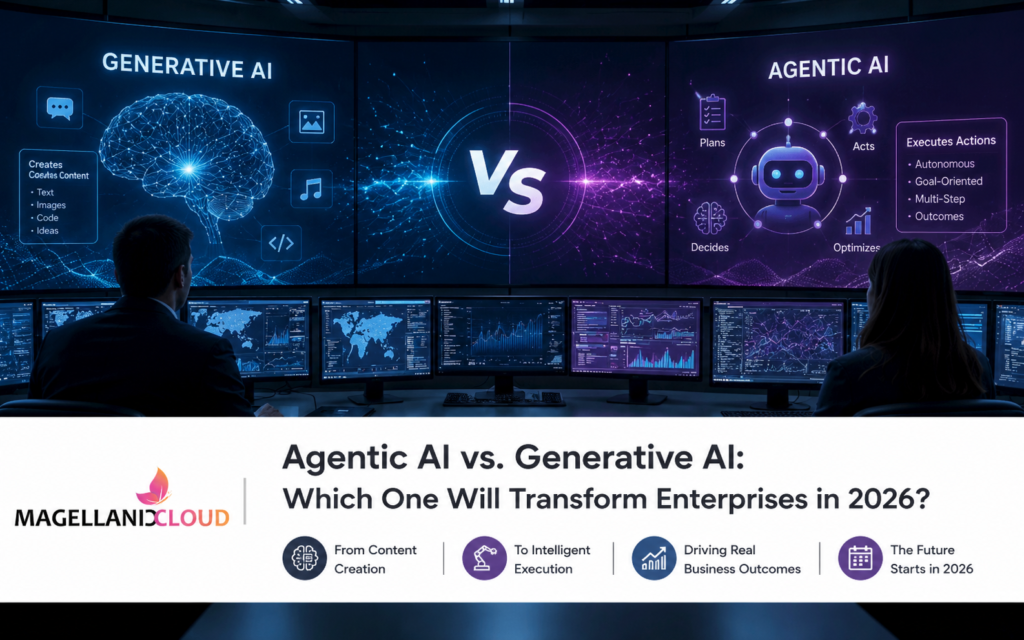
Artificial Intelligence has moved beyond being a futuristic concept to becoming a business imperative. From generating marketing content and writing code to automating customer support, Generative AI has transformed how organizations work. But as enterprises look to scale AI beyond productivity gains, a new paradigm is taking center stage, Agentic AI.
The conversation is no longer about Agentic AI vs. Generative AI because one technology is replacing the other. Instead, it’s about understanding how each technology addresses different business challenges and how, together, they can accelerate enterprise-wide digital innovation and transformation.
What is Generative AI?
Generative AI refers to AI models capable of creating new content such as text, images, videos, code, and audio based on user prompts. Popular applications include AI chatbots, content generation tools, software development assistants, and design automation platforms.
For enterprises, Generative AI has significantly improved employee productivity by enabling faster document creation, customer communication, software development, and knowledge retrieval.
Today, organizations are increasingly embedding Generative AI into everyday workflows. According to McKinsey’s State of AI report, 71% of organizations now regularly use Generative AI in at least one business function, highlighting how rapidly enterprise adoption has accelerated.
However, despite impressive productivity improvements, Generative AI still depends heavily on human instructions. It creates, but it rarely acts independently.
What is Agentic AI?
Agentic AI represents the next evolution of enterprise AI.
Unlike traditional Generative AI systems that wait for prompts, Agentic AI can independently plan, reason, execute tasks, and interact with multiple systems to accomplish predefined goals.
Think of an intelligent digital employee rather than a digital assistant.
An Agentic AI system can:
• Analyze business objectives
• Break complex tasks into smaller actions
• Access enterprise applications
• Make decisions within defined policies
• Learn from previous interactions
• Complete multi-step workflows with minimal human intervention
Instead of simply drafting an email, an AI agent could retrieve customer information, prepare a proposal, schedule meetings, update CRM records, and notify stakeholders, all without requiring repeated prompts.
This shift from “creating” to “doing” is what makes Agentic AI particularly attractive for enterprise digital transformation.
Agentic AI vs. Generative AI: Key Differences
Although both technologies are powered by advanced AI models, their capabilities differ significantly.
Feature | Generative AI | Agentic AI |
Primary purpose | Creates content | Executes business tasks |
Human involvement | Requires prompts | Operates with defined autonomy |
Decision-making | Limited | Goal-oriented reasoning |
Workflow execution | Single-task responses | Multi-step process automation |
Enterprise value | Productivity enhancement | Business process transformation |
Rather than competing technologies, they complement one another. Generative AI produces high-quality outputs, while Agentic AI orchestrates actions that convert those outputs into measurable business outcomes.
Agentic AI vs. Generative AI Examples
Understanding practical enterprise use cases makes the distinction much clearer.
Customer Support
Generative AI
- Drafts customer responses
- Summarizes conversations
- Suggests knowledge articles
Agentic AI
- Identifies customer intent
- Creates support tickets
- Escalates critical issues
- Schedules technician visits
- Updates CRM automatically
Software Development
Generative AI
- Generates code snippets
- Explains programming concepts
- Assists with debugging
Agentic AI
- Reviews repositories
- Executes testing pipelines
- Fixes identified issues
- Deploys approved code
- Monitors production performance
Finance Operations
Generative AI
- Creates financial reports
- Summarizes transactions
- Drafts compliance documentation
Agentic AI
- Validates invoices
- Detects anomalies
- Routes approvals
- Initiates payments
- Generates audit trails
The difference is simple: Generative AI provides intelligence, while Agentic AI delivers execution.
Why Enterprises Are Moving Toward Agentic AI
Enterprise leaders are no longer satisfied with AI tools that simply generate answers. Their focus has shifted toward measurable business outcomes, operational efficiency, and end-to-end workflow automation.
Organizations are increasingly seeking AI systems capable of managing repetitive, rule-based processes across departments while allowing employees to focus on strategic decision-making.
This growing interest is reflected in market research. Gartner predicts that 40% of enterprise applications will feature task-specific AI agents by the end of 2026, compared with less than 5% in 2025, demonstrating how quickly Agentic AI is expected to become part of mainstream enterprise software.
As businesses mature in their AI journey, autonomous agents are becoming a natural extension of existing digital transformation initiatives.
Does Agentic AI Replace Generative AI?
Not at all.
One of the biggest misconceptions surrounding Agentic AI is that it will replace Generative AI. In reality, the two technologies work best together.
A Generative AI model may create a personalized proposal, while an Agentic AI system can distribute it, obtain approvals, schedule follow-ups, update internal systems, and monitor customer responses.
Similarly, Generative AI can summarize customer feedback, while Agentic AI analyzes trends, prioritizes issues, creates engineering tickets, and tracks resolution progress.
This collaboration enables organizations to move from isolated AI use cases toward intelligent enterprise ecosystems.
Choosing the Right AI Strategy
The choice between Agentic AI and Generative AI should be driven by business objectives rather than technology trends.
Organizations looking to improve creativity, employee productivity, documentation, and customer interactions can benefit significantly from Generative AI.
Meanwhile, businesses aiming to automate operations, streamline workflows, optimize decision-making, and reduce manual intervention should explore Agentic AI.
For many enterprises, the optimal strategy isn’t selecting one over the other, it is integrating both technologies into a unified AI ecosystem that supports end-to-end digital transformation.
Future Outlook
The future of enterprise AI will not be defined by standalone chatbots or isolated automation tools. Instead, organizations are moving toward intelligent ecosystems where Generative AI creates knowledge and Agentic AI transforms that knowledge into action.
As governance frameworks, enterprise integrations, and AI infrastructure continue to mature, businesses will increasingly deploy AI agents capable of managing complex workflows with greater accuracy, speed, and accountability. Enterprises that invest today in scalable AI architectures, responsible governance, and human-AI collaboration will be better positioned to unlock long-term competitive advantage.
In 2026 and beyond, the question will no longer be “Agentic AI vs. Generative AI?” The real opportunity lies in leveraging both technologies together to build smarter, faster, and more resilient enterprises that are ready for the next era of AI-driven transformation.
FAQs
1. What is Agentic AI vs. Generative AI?
Generative AI creates content, while Agentic AI autonomously plans, makes decisions, and executes multi-step tasks to achieve business goals.
2. What are Agentic AI vs. Generative AI examples?
Generative AI writes emails or generates code, whereas Agentic AI can schedule meetings, update CRM systems, and complete end-to-end workflows independently.
3. What are the differences between Agentic AI and Generative AI?
The key difference is that Generative AI focuses on content creation, while Agentic AI focuses on autonomous task execution and workflow automation.
4. Which is better: Agentic AI or Generative AI?
Neither is inherently better; Generative AI enhances creativity and productivity, while Agentic AI drives operational efficiency, making them most effective when used together.
5. What is the difference between Agentic AI and Generative AI?
Agentic AI goes beyond generating responses by reasoning, planning, and taking actions, whereas Generative AI primarily generates text, images, code, or other content.