Why AI Video Analytics Is the Biggest Leap in Security Since CCTV?
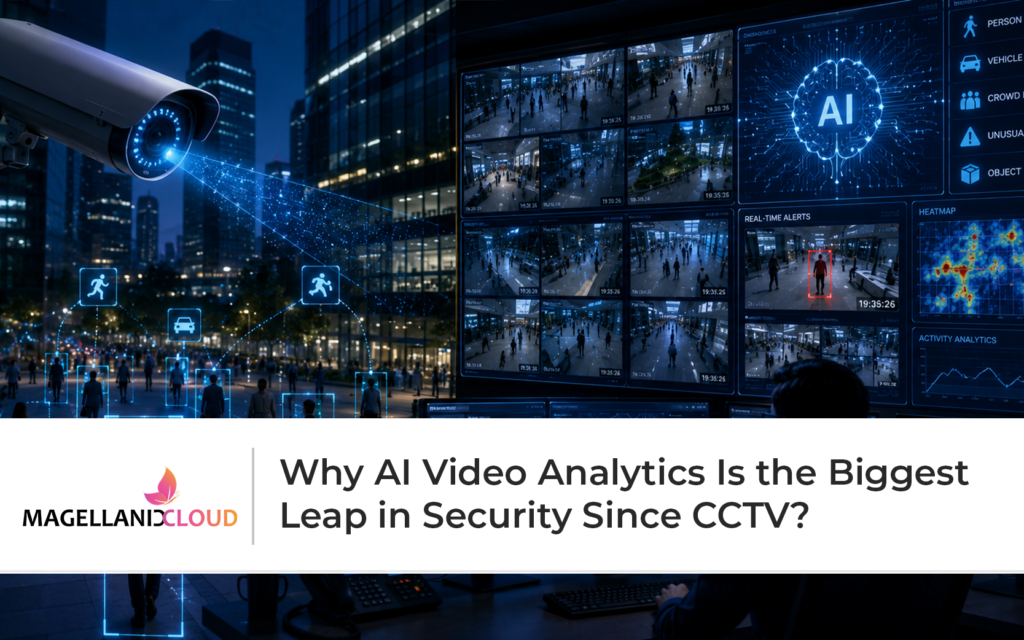
Walk into any railway station, airport, corporate office, or manufacturing plant today, and you’ll notice one thing they all have in common: cameras, that too a thousand of them.
For years, these security systems have quietly recorded everything that happened around them. If an incident occurred, investigators would rewind hours of footage, hoping to find a crucial moment. Surveillance was reactive. Cameras acted as silent witnesses rather than active participants.
That model no longer works.
Today’s enterprises don’t need more video footage. They need faster decisions. They need systems that can distinguish between routine activity and genuine threats in real time. They need intelligence instead of observation.
This is where AI video analytics is transforming the future of surveillance.
Rather than simply recording events, modern video content analytics platforms analyse live video feeds, recognise behavioural patterns, identify anomalies, and generate alerts within seconds. A traditional CCTV camera tells you what happened. Now, an AI-powered surveillance platform can predict what could happen next.
As organisations continue investing in digital infrastructure, AI video analysis is becoming the foundation of next-generation smart surveillance systems, reshaping everything from public safety and industrial security to critical infrastructure management.
Why Traditional Security Systems Are No Longer Enough
Traditional surveillance systems were built for a different era.
Their primary objective was simple: capture footage, store it, and retrieve it later if required. While this approach improved evidence collection, it placed enormous dependence on human operators.
Imagine a city-wide surveillance network with 10,000 cameras.
Even the most experienced control room operator cannot simultaneously monitor every screen for every suspicious movement. Fatigue sets in. Important incidents get overlooked. Response times increase.
According to research by the National Institute of Standards and Technology (NIST), human operators experience significant declines in attention when monitoring multiple video feeds over extended periods, reducing the effectiveness of manual surveillance.
The challenge becomes even greater in environments like airports, railway stations, highways, manufacturing plants, ports, or smart cities where millions of events occur daily.
The issue is not camera coverage anymore. It is information overload.
Modern security systems need intelligence capable of filtering thousands of routine activities while immediately highlighting the few that genuinely require attention.
That is precisely where AI video analytics changes the equation.
AI Video Analytics Is Teaching Cameras to Think
Artificial intelligence has fundamentally changed what surveillance cameras are capable of.
An artificial intelligence security camera does far more than record video. It continuously analyses live footage using computer vision and machine learning algorithms to identify people, vehicles, behaviours, and environmental conditions.
Instead of waiting for a human operator to notice unusual activity, an AI security camera can automatically detect:
- abandoned objects
- perimeter breaches
- crowd formation
- loitering
- wrong-way vehicle movement
- unauthorised access
- smoke or fire indicators
The technology powering these capabilities is known as video analytics AI.
According to Gartner, video analytics has evolved from simple motion detection into sophisticated behavioural analysis powered by artificial intelligence, enabling organisations to shift from reactive surveillance to proactive risk management.
This evolution marks the beginning of what many industry experts call smart surveillance systems, where cameras become active decision-support tools rather than passive recording devices.
CCTV Artificial Intelligence Is Changing Every Industry
The impact of CCTV artificial intelligence extends far beyond traditional security.
In manufacturing, AI-based CCTV cameras monitor production lines to detect safety violations, equipment anomalies, and operational inefficiencies before they escalate into costly disruptions.
In airports, AI CCTV systems analyse passenger flow to optimise security checkpoints and reduce congestion.
In retail, intelligent surveillance helps identify suspicious behaviour while also generating customer movement insights that improve store layouts.
Healthcare institutions use artificial intelligence cameras to monitor restricted areas, detect falls, and enhance patient safety without requiring constant manual supervision.
Critical infrastructure operators increasingly deploy AI security cameras across power plants, metro stations, highways, and ports to improve operational resilience.
According to MarketsandMarkets, the global video analytics market is projected to witness strong double-digit growth over the coming years, driven by increasing adoption of AI-powered surveillance across transportation, smart cities, industrial automation, and critical infrastructure.
From Cameras to Intelligent Systems
One of the biggest misconceptions surrounding AI surveillance is that it simply makes cameras smarter.
In reality, the camera is only one part of a much larger ecosystem.
Modern intelligent systems combine multiple technologies including:
- AI video analytics
- IoT sensors
- cloud computing
- edge processing
- GIS integration
- real-time dashboards
- incident management platforms
Together, these technologies transform isolated cameras into connected digital ecosystems capable of monitoring, analysing, predicting, and responding simultaneously.
For example, if an AI-based CCTV camera identifies a vehicle travelling in the wrong direction on a highway, the response does not end with an alert.
The system can automatically:
- notify nearby traffic authorities,
- display warnings on variable message signs,
- trigger emergency workflows,
- record the incident,
- and archive evidence for future analysis.
This level of automation dramatically reduces response times while improving public safety.
Why AI Video Analytics Is Becoming the Brain of Smart Cities
India’s Smart Cities Mission has accelerated investments in surveillance infrastructure across transportation networks, municipal operations, and public spaces.
However, installing thousands of cameras solves only one part of the challenge.
The real value emerges when those cameras become intelligent.
Integrated Command and Control Centres (ICCCs) increasingly rely on AI video analytics to consolidate information from CCTV networks, IoT devices, emergency communication systems, environmental sensors, and public utilities into unified operational dashboards.
According to the Ministry of Housing and Urban Affairs, more than 80 Integrated Command and Control Centres have already been established across India’s Smart Cities, serving as central hubs for urban operations and emergency response.
Instead of manually reviewing video feeds, authorities can now receive real-time alerts for:
- traffic congestion,
- accidents,
- illegal parking,
- crowd movement,
- public safety incidents,
- environmental hazards,
- and infrastructure failures.
This transition represents the next evolution of smart surveillance systems, where intelligence becomes the centrepiece of urban management rather than surveillance alone.
Security Is Becoming Predictive, Not Reactive
Perhaps the biggest transformation brought by AI video analytics is its ability to predict risks before incidents occur.
Traditional surveillance answered one question: “What happened?”
Modern AI answers two more important ones: “What is happening and what is likely to happen next?”
By continuously analysing behavioural patterns, movement trends, and historical data, video content analytics platforms can identify subtle indicators that often precede security incidents.
These may appear insignificant individually. Together, they form behavioural signals that intelligent surveillance systems recognise almost instantly.
The future of surveillance is now about preventing the event altogether.
AI Surveillance Is Powering India's Critical Infrastructure
India’s infrastructure is undergoing one of its largest digital transformations.
Railway stations are becoming smarter. Highways are becoming connected. Airports, ports, manufacturing plants, data centers, educational institutions, and smart cities are investing heavily in intelligent monitoring systems.
The Government of India’s Smart Cities Mission has already established more than 80 Integrated Command and Control Centers (ICCCs), bringing together CCTV networks, IoT devices, environmental sensors, emergency communication systems, and traffic management platforms into unified operational centres.
At the same time, Indian Railways continues expanding AI-enabled surveillance across stations and operational assets to improve passenger safety and infrastructure monitoring. Similarly, the Ministry of Road Transport and Highways is deploying Intelligent Traffic Management Systems (ITMS) that increasingly rely on AI-enabled video monitoring.
These developments reflect a broader industry shift.
The camera is becoming an intelligent sensor rather than simply a recording device.
Whether monitoring crowd movement during festivals, detecting unauthorised access in industrial plants, identifying traffic violations on expressways, or monitoring operational safety inside warehouses, AI video analytics is becoming the digital nervous system of India’s critical infrastructure.
The Future Lies in Predictive Security
Perhaps the greatest advantage of AI security cameras lies in their ability to detect behavioural patterns rather than isolated events.
Traditional surveillance depended on incidents occurring first.
Modern artificial intelligence and security platforms continuously analyse movement, behaviour, timing, and environmental context to identify risks before they escalate.
For example, repeated loitering near a restricted area may appear harmless in isolation. However, when analysed over several hours alongside access logs, vehicle movement, and historical behaviour, AI may identify a developing security risk that no individual operator would notice.
Similarly, video content analytics can detect abnormal crowd formation during public events long before congestion becomes dangerous.
The emphasis is shifting from “recording evidence” to “preventing incidents.” For enterprises, this translates into lower operational risk, faster response times, and improved business continuity.
Why Cloud, Edge, and AI Must Work Together
The future of surveillance does not depend on cameras alone.
It depends on architecture.
Modern intelligent systems combine edge computing, cloud infrastructure, IoT connectivity, and AI models into a unified ecosystem.
Edge AI enables an artificial intelligence security camera to process events locally with almost zero latency. This is essential for applications such as traffic monitoring, manufacturing safety, and public infrastructure where milliseconds matter.
Cloud platforms provide long-term storage, large-scale analytics, historical trend analysis, and enterprise-wide visibility.
Together, edge and cloud create a hybrid architecture capable of supporting enterprise-scale AI video analysis.
This architecture allows organisations to process millions of video events daily without overwhelming network infrastructure while still maintaining centralised governance and operational intelligence.
Magellanic Cloud's Vision: From Surveillance to Situational Intelligence
At Magellanic Cloud Limited, we believe the future of surveillance extends far beyond cameras.
Through Scanalitix, we are helping organisations transform traditional e-surveillance into intelligent, AI-driven operational ecosystems capable of supporting security, governance, and business continuity simultaneously.
Scanalitix enables enterprises to integrate multiple surveillance technologies within one scalable platform, combining AI video analytics, video content analytics, intelligent alert management, AI-assisted workflows, and real-time monitoring into a unified command environment.
Our platform supports cloud, on-premise, and hybrid deployments, making it adaptable across diverse industries including transportation, manufacturing, critical infrastructure, education, healthcare, smart cities, banking, and enterprise campuses.
The objective is to generate meaningful intelligence that improves operational efficiency, accelerates decision-making, and strengthens organisational resilience.
As India’s digital infrastructure continues to expand, organisations will increasingly require surveillance platforms that think, learn, and adapt alongside evolving risks.
That future has already begun.
Conclusion: Cameras Are No Longer the Product. Intelligence Is.
For decades, surveillance technology focused on expanding visibility. More cameras meant better security. Today, that equation has changed. Visibility without intelligence creates information overload.
Modern enterprises require surveillance platforms capable of interpreting situations, recognising behavioural patterns, automating workflows, and supporting faster decisions.
That is why AI video analytics is rapidly becoming the foundation of next-generation security systems.
The evolution from CCTV to cognitive surveillance represents far more than a technological upgrade. It reflects a fundamental shift in how organisations think about safety, operations, and resilience.
In the coming years, the most valuable surveillance systems will be the ones capable of delivering the smartest insights. Because the future of security is about understanding.
Frequently Asked Questions - FAQs
Q1. What is AI security?
Ans: AI security refers to the application of artificial intelligence technologies to identify, analyse, predict, and respond to security threats automatically. Unlike conventional surveillance, AI-powered security systems continuously learn from data, enabling faster and more accurate threat detection.
Q2. What is an AI security camera?
Ans: An AI security camera is equipped with computer vision and machine learning capabilities that allow it to recognise objects, people, vehicles, behaviours, and anomalies in real time. It transforms traditional CCTV into an intelligent surveillance system.
Q3. What is system security?
Ans: System security involves protecting physical and digital assets from unauthorised access, cyber threats, operational risks, and security breaches using technology, governance, and monitoring frameworks.
Q4. What is a rule-based system in artificial intelligence?
Ans: A rule-based AI system follows predefined logical rules to make decisions. Modern surveillance platforms combine rule-based logic with machine learning, allowing systems to recognise complex behavioural patterns while continuously improving accuracy.
Q5. What is Business Intelligence (BI)?
Ans: Business Intelligence refers to technologies that collect and visualise historical business data through reports and dashboards. AI-powered surveillance platforms extend beyond BI by enabling real-time decision-making and predictive analytics.