Edge vs Cloud: Where Should India’s Enterprises Place Their AI Bets?
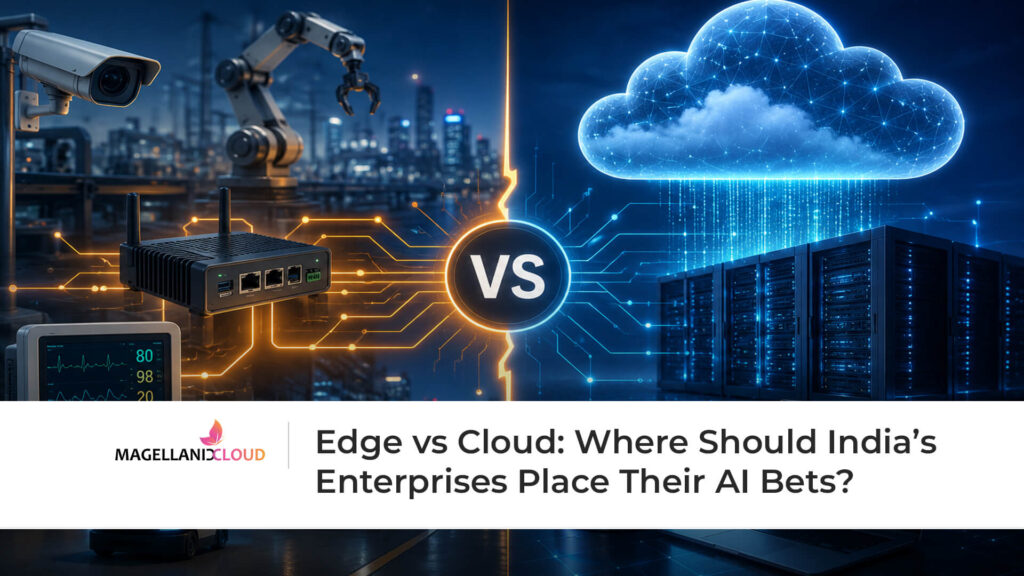
A surveillance camera on a highway detects a stalled truck in real time. Within seconds, traffic authorities receive an alert, nearby routes are adjusted, and emergency response teams are notified.
At the same moment, a fintech platform processes thousands of transactions across cities, using AI models hosted on cloud servers to identify fraud patterns before customers even notice suspicious activity.
Both systems use artificial intelligence. Both rely on data. Yet the way they process that intelligence is fundamentally different.
One happens at the edge. The other happens in the cloud.
As India accelerates toward an AI-driven economy, enterprises are facing a critical technology decision:
Where should AI actually live?
Understanding the Difference Between Edge and Cloud AI
For years, cloud computing dominated enterprise transformation. Organisations moved workloads to cloud platforms for scalability, storage, and computational power. AI adoption naturally followed this path because training large models requires enormous processing capabilities.
Cloud AI works by sending data to centralised servers where models process information and return outputs. It is powerful, scalable, and efficient for complex analytics.
Edge AI works differently.
Instead of sending all data to central servers, AI processing happens closer to the source of data generation, directly on devices, sensors, cameras, or local infrastructure.
For example:
- an AI-enabled CCTV camera detecting suspicious movement locally
- a manufacturing sensor identifying anomalies in real time
- a drone processing aerial intelligence during flight
According to Gartner, edge computing is becoming essential for enterprises that require low latency, real-time processing, and decentralised intelligence.
The debate is no longer “AI or not.” It is “where should AI compute?”
Why Cloud Became the Default AI Infrastructure
Cloud computing transformed enterprise technology because it solved one major problem: scale.
Organisations no longer needed expensive on-premise infrastructure. Cloud platforms provided:
- virtually unlimited storage
- elastic computing power
- AI development environments
- centralised data processing
This allowed enterprises to train machine learning models faster and deploy services globally.
According to IDC, enterprise cloud adoption continues to accelerate as organisations prioritise scalability and digital transformation.
For AI workloads involving massive datasets, predictive modelling, and enterprise-wide analytics, the cloud remains indispensable.
India’s fintech ecosystem, e-commerce platforms, and enterprise SaaS companies rely heavily on cloud-native AI architectures because they require flexibility and scale.
The Problem With Sending Everything to the Cloud
As AI adoption expands into physical infrastructure, relying entirely on the cloud introduces challenges.
Latency becomes critical.
A self-driving system cannot wait seconds for cloud servers to process data. An AI surveillance system monitoring a crowded railway platform cannot afford delayed anomaly detection.
Bandwidth is another issue. Billions of IoT devices, cameras, and sensors generate enormous volumes of data. Transmitting all this data continuously to centralised servers is inefficient and expensive.
There are also concerns around:
- connectivity reliability
- data privacy
- operational continuity during network outages
This is where edge AI becomes essential.
The Problem With Sending Everything to the Cloud
As AI adoption expands into physical infrastructure, relying entirely on the cloud introduces challenges.
Latency becomes critical.
A self-driving system cannot wait seconds for cloud servers to process data. An AI surveillance system monitoring a crowded railway platform cannot afford delayed anomaly detection.
Bandwidth is another issue. Billions of IoT devices, cameras, and sensors generate enormous volumes of data. Transmitting all this data continuously to centralised servers is inefficient and expensive.
There are also concerns around:
- connectivity reliability
- data privacy
- operational continuity during network outages
This is where edge AI becomes essential.
Edge AI: Intelligence at the Source
Edge computing shifts intelligence closer to where data originates.
Instead of sending raw data to distant cloud servers, edge devices process information locally and transmit only relevant insights when necessary.
This approach dramatically reduces latency.
According to McKinsey & Company, edge AI enables faster decision-making and operational efficiency across sectors such as manufacturing, infrastructure, and mobility.
For India’s growing smart infrastructure ecosystem, this matters enormously.
AI-powered traffic systems, industrial automation platforms, surveillance networks, and drone operations increasingly require real-time responsiveness. In such environments, milliseconds matter.
India’s Enterprise Reality: Why the Answer Is Not Either-Or
The edge versus cloud debate often creates a false binary.
In reality, most enterprises will require both.
Cloud infrastructure excels at:
- large-scale AI training
- long-term data storage
- enterprise analytics
- cross-regional scalability
Edge infrastructure excels at:
- low-latency processing
- real-time monitoring
- operational resilience
- localised intelligence
The future lies in hybrid AI architectures, where cloud and edge complement each other.
A smart city surveillance system, for example, may use edge AI to process live camera feeds locally while using cloud platforms for large-scale analytics and historical trend analysis.
Similarly, industrial IoT systems may detect equipment failures at the edge while sending aggregated insights to cloud dashboards.
The winning strategy is integration, not replacement.
AI at the Edge: India’s Infrastructure Opportunity
India’s rapid infrastructure digitisation makes edge AI especially relevant.
Integrated Command and Control Centres (ICCCs), smart highways, railway modernisation projects, and industrial automation systems generate vast streams of real-time data.
Processing all this centrally is impractical.
According to the Government of India’s Smart Cities Mission, cities are increasingly integrating AI-enabled systems for traffic management, surveillance, and public services.
Edge AI enables these systems to operate with greater speed and reliability.
The same applies to sectors such as:
- healthcare diagnostics
- manufacturing automation
- logistics tracking
- agriculture monitoring through drones and IoT
India’s AI future will not exist only inside data centres. It will exist at intersections, factories, farms, highways, and railway stations.
Data Sovereignty and Security Concerns
Another major factor driving edge adoption is data governance.
As enterprises process sensitive operational and consumer data, questions around privacy, sovereignty, and compliance become more important.
Keeping certain data local rather than transmitting it externally helps organisations reduce exposure risks and comply with regulatory frameworks.
The OECD emphasises the importance of trustworthy AI systems that ensure transparency, accountability, and secure data governance. For sectors such as BFSI, defence, public infrastructure, and healthcare, edge AI can strengthen operational security while reducing dependency on external connectivity.
The Infrastructure Challenge Ahead
Despite its advantages, edge AI also introduces complexity.
Enterprises must manage:
- distributed infrastructure
- device interoperability
- security across endpoints
- data synchronisation between edge and cloud systems
This requires robust architecture design and integration expertise.
According to the World Economic Forum, successful AI adoption increasingly depends on the ability to integrate distributed digital systems into unified operational ecosystems. The future of enterprise AI will depend not only on algorithms, but on infrastructure orchestration.
How Magellanic Cloud and Motivity Labs Enable Hybrid AI Infrastructure
At Magellanic Cloud Limited, we believe the future of enterprise AI is hybrid, intelligent, and distributed.
Through Motivity Labs, our digital engineering and cloud transformation arm, we help enterprises design AI ecosystems that combine the scalability of cloud with the responsiveness of edge computing.
Our capabilities include:
- cloud-native AI infrastructure development
- edge-enabled analytics systems
- AI-ready data pipeline integration
- real-time processing architectures
- secure and scalable hybrid environments
Across MCL’s ecosystem, including surveillance, fintech, and drone intelligence platforms, we enable AI systems that function seamlessly across cloud and edge layers.
Whether it is AI video analytics, predictive financial systems, or drone-based intelligence platforms, our focus remains the same: delivering intelligence where it creates the greatest operational impact.
How Magellanic Cloud and Motivity Labs Enable Hybrid AI Infrastructure
At Magellanic Cloud Limited, we believe the future of enterprise AI is hybrid, intelligent, and distributed.
Through Motivity Labs, our digital engineering and cloud transformation arm, we help enterprises design AI ecosystems that combine the scalability of cloud with the responsiveness of edge computing.
Our capabilities include:
- cloud-native AI infrastructure development
- edge-enabled analytics systems
- AI-ready data pipeline integration
- real-time processing architectures
- secure and scalable hybrid environments
Across Magellanic’s ecosystem, including e-surveillance, fintech, and drone intelligence platforms, we enable AI systems that function seamlessly across cloud and edge layers.
Whether it is AI video analytics, predictive financial systems, or drone-based intelligence platforms, our focus remains the same: delivering intelligence where it creates the greatest operational impact.
The Future Is Distributed Intelligence
The next decade of enterprise AI will not belong exclusively to the cloud or the edge.
It will belong to organisations capable of combining both intelligently.
Cloud platforms will remain essential for large-scale analytics and AI training. Edge systems will power real-time responsiveness and decentralised decision-making.
Together, they form the architecture of modern AI infrastructure.
The real competitive advantage will not come from choosing one side. It will come from knowing how to orchestrate both.
Conclusion: India’s AI Bet Is Bigger Than Infrastructure Alone
India’s AI economy is growing rapidly, but the success of that transformation depends on infrastructure decisions made today.
The edge versus cloud conversation is ultimately not about technology preferences. It is about business outcomes:
- speed
- resilience
- scalability
- intelligence
Enterprises that treat AI infrastructure strategically will move faster, respond smarter, and operate more efficiently.
Because in the age of AI, where intelligence lives may matter just as much as the intelligence itself.