Who Owns Your Data? The New Battle Between Nations, Corporates, and Consumers
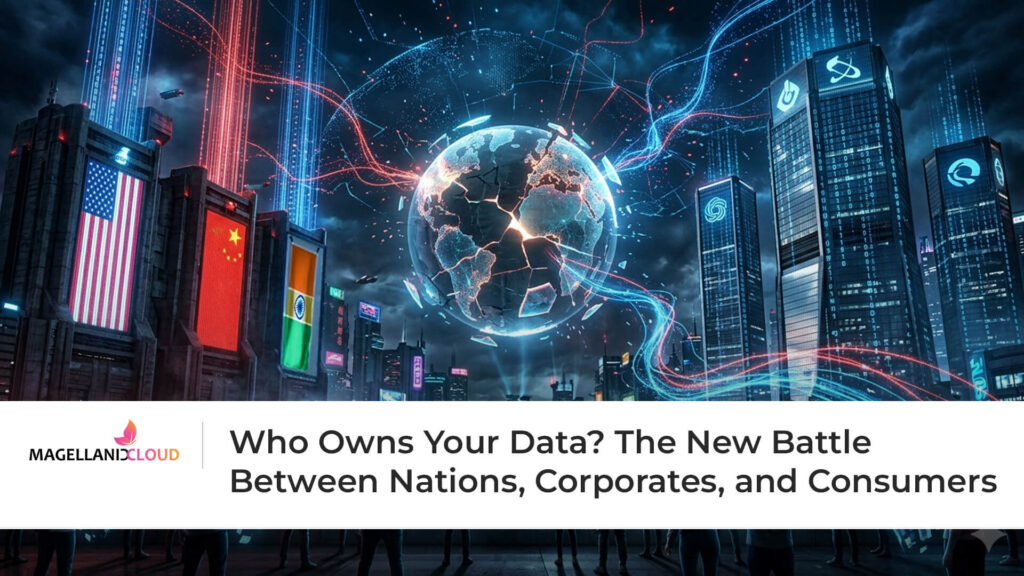
Every time you make a payment, stream a video, search for information, or swipe through an app, you generate data. It feels intangible, almost weightless. Yet this invisible byproduct of digital life has quietly become one of the most valuable assets in the global economy.
The question is no longer whether data has value. That is settled.
The real question is: who owns it?
Governments want control over it. Corporations monetise it. Consumers generate it. Regulators attempt to protect it. And somewhere between these competing interests lies the future of the digital economy.
Data: The New Currency of Power
Data has evolved from a byproduct of digital activity into a strategic resource that drives innovation, economic growth, and geopolitical influence.
According to World Economic Forum, data is now a critical asset underpinning digital transformation across industries, from finance and healthcare to infrastructure and governance.
Global tech giants have built entire business models around data collection, analysis, and monetisation. Algorithms trained on massive datasets power everything from personalised recommendations to predictive analytics.
Meanwhile, governments increasingly recognise that data sovereignty, the ability to control data generated within their borders, is directly linked to national security and economic independence.
This convergence has created a new kind of contest: one that is not fought over land or resources, but over information.
The Corporate Control Model
For years, large technology companies have dominated the data ecosystem. Their platforms collect user data at scale, analyse behaviour patterns, and generate insights that drive targeted advertising, product innovation, and market expansion.
This model has been extraordinarily successful.
According to McKinsey & Company, data-driven organisations are significantly more likely to acquire customers and achieve above-average profitability.
However, this concentration of data power has raised concerns around transparency, consent, and accountability. Users often remain unaware of how their data is used, shared, or monetised.
The imbalance is clear. Corporates collect and control vast amounts of data, while consumers generate it with limited visibility.
The Rise of Data Sovereignty
Governments around the world are responding by asserting greater control over data flows.
Data sovereignty refers to the principle that data generated within a country should be subject to its laws and governance frameworks. This has led to regulations around data localisation, cross-border data transfers, and digital privacy.
India is actively shaping its approach through frameworks such as the Digital Personal Data Protection Act and sectoral regulations.
According to NITI Aayog, data governance is central to India’s vision of building a secure and inclusive digital economy.
Similarly, the European Union’s GDPR has set global benchmarks for data protection, influencing policies worldwide.
The objective is clear: ensure that data is not just extracted, but governed responsibly within national frameworks.
The Consumer Awakening
While governments and corporations negotiate control, consumers are becoming more aware of their role in the data ecosystem.
Users are beginning to question:
- Who has access to their data?
- How is it being used?
- What rights do they have over it?
The concept of data ownership is evolving. Increasingly, individuals expect transparency, consent, and control over their digital footprints.
According to Pew Research Center, a majority of internet users express concern about how their data is collected and used by companies.
This shift is pushing organisations to rethink how they handle data, not just as an asset, but as a responsibility.
The Governance Challenge
Balancing the interests of nations, corporations, and consumers is not straightforward.
Too much regulation can stifle innovation. Too little can lead to misuse and loss of trust.
The OECD emphasises that data governance frameworks must strike a balance between enabling data-driven innovation and protecting individual rights.
This requires:
- transparent data policies
- secure data infrastructure
- clear consent mechanisms
- accountability frameworks
Governance is no longer a compliance exercise. It is a strategic necessity.
Data Infrastructure: The Real Battleground
While debates around ownership dominate headlines, the real battleground lies in infrastructure.
Data must be stored, processed, secured, and transmitted. These functions require robust digital infrastructure, including cloud platforms, data centres, and integration layers.
Countries are investing heavily in building sovereign cloud capabilities and secure data ecosystems.
According to IDC, global data volumes are growing exponentially, driving demand for scalable and secure infrastructure.
Control over infrastructure often translates into control over data flows.
In this context, ownership is not just about rights. It is about capability.
India’s Opportunity: Building a Trusted Data Ecosystem
India has a unique opportunity to shape a balanced data ecosystem that supports innovation while protecting citizens.
The country’s digital public infrastructure – spanning identity, payments, and governance platforms, provides a strong foundation.
However, scaling this ecosystem requires:
- interoperable data systems
- secure cloud infrastructure
- AI-ready data pipelines
- regulatory alignment
The World Economic Forum highlights that trusted data ecosystems are essential for enabling digital economies at scale.
Trust will determine adoption. Adoption will determine impact.
Magellanic Cloud’s Role: Building Trust Through Technology
At Magellanic Cloud Limited (MCL), we view data not just as a resource, but as a responsibility.
Across our group companies and platforms, we work at the intersection of data infrastructure, AI, cloud, and governance, helping enterprises and public institutions build systems that are both intelligent and trustworthy.
Our approach focuses on:
- Designing secure, scalable cloud architectures that protect data integrity.
- Building AI-ready data pipelines that ensure real-time processing and compliance.
- Integrating systems to enable seamless data flow across platforms.
- Embedding governance frameworks that align with regulatory requirements.
- Ensuring transparency and accountability in AI-driven decision systems.
Through solutions spanning surveillance, fintech, cloud engineering, and analytics, MCL contributes to creating trusted digital ecosystems where data can be used responsibly and effectively.
We do not just enable data-driven innovation. We enable responsible data-driven innovation.
The Future of Data Ownership
The question “Who owns your data?” does not have a simple answer.
Ownership is evolving into a shared model:
- Governments define the rules
- Corporations build the platforms
- Consumers generate and increasingly control the data
The future will likely involve collaborative frameworks where data flows securely across ecosystems while respecting rights and regulations.
Technologies such as federated learning, privacy-preserving computation, and decentralised data models are already exploring ways to balance access with protection.
Conclusion: Power, Responsibility, and the Path Forward
Data is power. But power without responsibility creates imbalance.
As nations assert sovereignty, corporations innovate, and consumers demand transparency, the data ecosystem is entering a new phase—one defined not just by access, but by accountability.
The next decade will not be shaped by who collects the most data, but by who manages it responsibly, securely, and ethically.
In this evolving landscape, organisations that prioritise trust, governance, and infrastructure will lead.
Because in the end, the true value of data lies not in ownership alone, but in how responsibly it is used.