How Predictive AI Is Personalising Finance for India’s Next 100 Million Investors
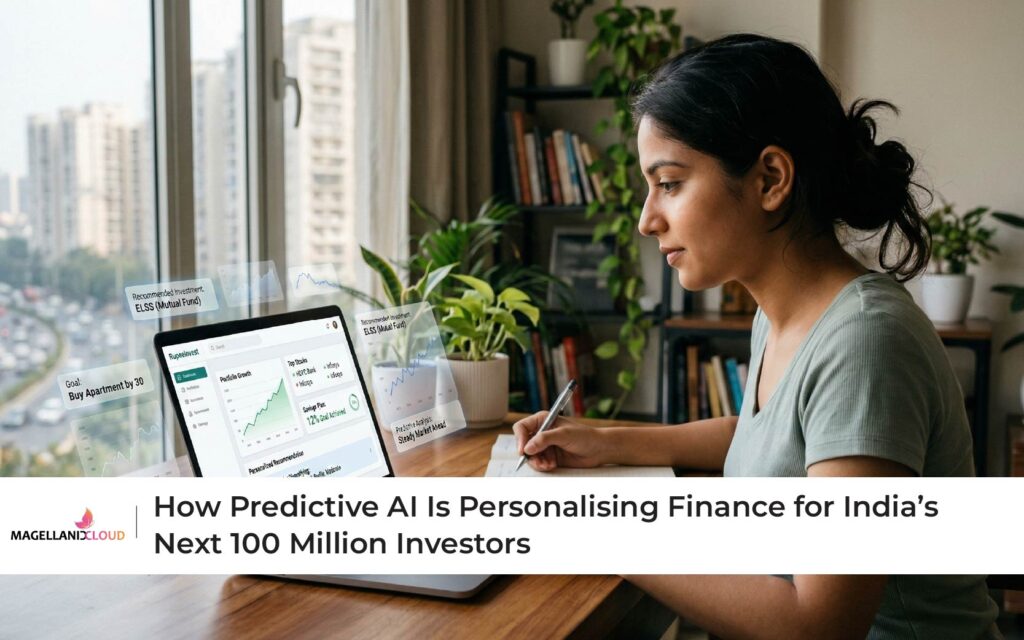
A young professional in Indore checks her phone after work. She is not a seasoned trader. She has never met a financial advisor. Yet within minutes, she reviews a portfolio suggestion tailored to her income, spending habits, and long-term goals. The app adjusts her investment recommendations automatically as her salary changes, flags risks when markets fluctuate, and nudges her to stay invested when volatility rises.
This is not traditional wealth management.
This is predictive AI-powered personal finance, and it is reshaping how India’s next 100 million investors will interact with money.
India is witnessing a structural shift in financial participation. Investing is no longer confined to urban elites or institutional players. It is becoming mainstream, digital, and increasingly intelligent.
India’s Retail Investing Boom
Over the last few years, India has seen an unprecedented rise in retail investors. According to data from the National Stock Exchange (NSE), the number of registered investors has crossed 10 crore (100 million), driven by digital platforms, mobile accessibility, and increased financial awareness.
Mutual fund participation has also grown significantly, with SIP (Systematic Investment Plan) inflows reaching record levels. This reflects a broader shift from saving to investing.
At the same time, digital payment platforms and fintech ecosystems have familiarised users with managing money online. UPI alone processes billions of transactions monthly, building trust in digital finance.
The next wave of growth will come from semi-urban and rural India, markets that require simplified, personalised, and accessible financial solutions.
The Limitations of Traditional Wealth Management
Traditional wealth management models were built around human advisors, high entry barriers, and standardised investment products. While effective for high-net-worth individuals, these models struggle to scale for mass retail audiences.
Advisors cannot realistically cater to millions of small-ticket investors with personalised attention. Static financial products often fail to reflect individual goals, risk profiles, or behavioural patterns.
As a result, many first-time investors either remain underserved or make uninformed decisions.
This is where AI changes the equation.
What Predictive AI Brings to Finance
Predictive AI uses historical data, behavioural signals, and real-time inputs to anticipate future outcomes and recommend actions.
In the context of finance, this means:
- analysing income patterns and spending behaviour
- predicting risk tolerance based on user activity
- forecasting market trends and portfolio performance
- dynamically adjusting investment strategies
According to McKinsey & Company, AI-driven analytics can significantly improve financial decision-making by combining large-scale data processing with predictive modelling.
Unlike static advisory models, predictive AI continuously learns and adapts.
Hyper-Personalisation: The New Standard
Personalisation in finance is no longer about segmenting users into broad categories. It is about creating individualised financial journeys.
AI systems can tailor investment recommendations based on life stage, income volatility, financial goals, and even behavioural biases such as risk aversion or impulsive trading.
For example, a gig worker with fluctuating income requires a different investment strategy than a salaried employee. Predictive AI can adjust allocations dynamically to reflect these realities.
According to Accenture, financial institutions that adopt hyper-personalisation see improved customer engagement and retention.
In India, where financial literacy levels vary widely, personalised guidance can make the difference between participation and exclusion.
Embedded Finance: Investing Where Users Already Are
One of the most transformative trends in fintech is embedded finance, the integration of financial services into non-financial platforms.
Investing is no longer confined to brokerage apps. It is becoming part of everyday digital experiences, within payment platforms, e-commerce ecosystems, and mobile applications.
This integration reduces friction and brings financial services closer to users.
According to Bain & Company, embedded finance is expected to grow rapidly as platforms leverage user data to offer contextual financial services.
Predictive AI plays a central role in this ecosystem by delivering relevant financial recommendations at the right moment.
Democratising Wealth Through AI
India’s next 100 million investors will not interact with finance the same way previous generations did. They will expect:
- simplicity over complexity
- guidance over guesswork
- automation over manual decision-making
AI-driven robo-advisory platforms enable this shift by lowering entry barriers and providing continuous, data-driven support.
The World Economic Forum highlights that digital financial services, when combined with AI, can significantly expand financial inclusion by reaching underserved populations.
This democratisation of wealth management aligns closely with India’s broader economic goals.
The Role of Data and Trust
As finance becomes more data-driven, trust becomes critical.
Users must feel confident that their data is secure, their investments are handled responsibly, and AI recommendations are transparent.
India’s regulatory environment, including guidelines from the Reserve Bank of India (RBI) and SEBI, emphasises responsible digital lending, investor protection, and data privacy.
AI systems must therefore be designed with explainability, compliance, and user trust at their core.
Finoux and Magellanic Cloud: Enabling Intelligent Finance
At Magellanic Cloud Limited (MCL), we recognise that the future of finance lies in combining technology with accessibility.
Through Finoux, our fintech and robo-advisory platform, we are building AI-driven financial solutions that bring personalised investing to a broader audience.
Finoux leverages predictive analytics to:
- generate customised investment strategies
- adapt portfolios dynamically based on market conditions
- provide real-time insights and recommendations
- support users in achieving long-term financial goals
By integrating AI with user-centric design, Finoux simplifies complex financial decisions.
Magellanic Cloud’s broader capabilities in AI, cloud infrastructure, and digital transformation strengthen this ecosystem, enabling scalable and secure financial platforms.
Our focus is not just on enabling investments, but on enabling informed investing.
The Road Ahead: Finance That Thinks Ahead
The future of finance in India will not be defined by products alone, but by intelligence.
Predictive AI will continue to evolve, incorporating more data sources, improving accuracy, and delivering deeper personalisation. As adoption grows, financial services will become more proactive, guiding users toward better outcomes.
India’s next 100 million investors will not need to navigate markets alone. They will have AI systems that:
- anticipate risks
- optimise portfolios
- encourage disciplined investing
- adapt to life changes
This transformation marks a shift from reactive finance to anticipatory finance.
Conclusion: From Access to Empowerment
India has already achieved remarkable progress in financial inclusion. The next phase is about financial empowerment.
Predictive AI is enabling this shift by turning data into decisions and complexity into clarity.
As investing becomes more accessible, personalised, and intelligent, millions of Indians will gain the confidence to participate in wealth creation.
The future of finance is not just digital.
It is personal. It is predictive. It is built for scale.