Why AI Crowd Monitoring Matters in 2026
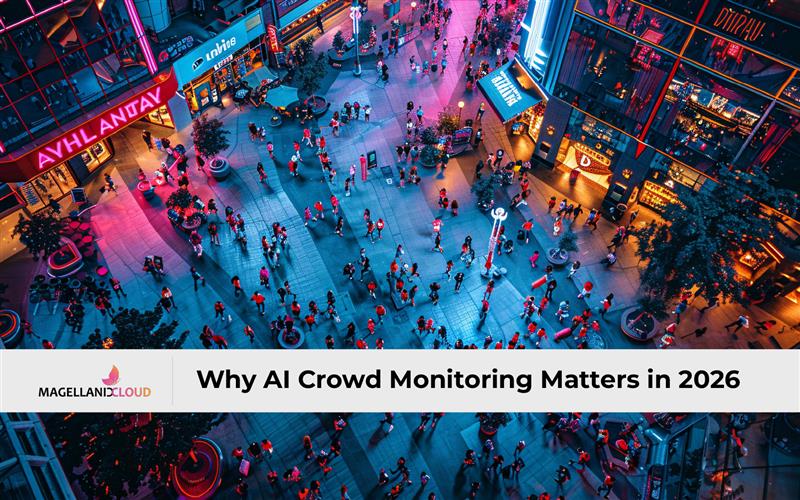
What happens when millions of people move at the same time? Who notices the first sign of danger? And who decides, in those few critical seconds, how to act?
In 2026, these are no longer abstract questions. They are everyday operational realities for cities, event organizers, transport authorities, and public safety agencies across the world. As urban populations grow and mass gatherings become larger and more frequent, traditional surveillance methods are reaching their limits.
This is where artificial intelligence enters the picture – not as an experimental upgrade, but as a core layer of modern public infrastructure.
This blog explores why AI-driven crowd monitoring has become essential in 2026, how the technology is reshaping safety and governance, and why Crowd Monitoring in Digital India is emerging as a defining model for the future.
The New Reality of Crowds in a Hyper-Connected World
Crowds today are fundamentally different from crowds a decade ago.
They are larger.
They are faster-moving.
And they operate within digitally dense environments — metros, airports, stadiums, pilgrimage routes, smart cities, and transport corridors.
Every day, millions of people flow through systems that were never designed for this scale.
Manual monitoring answers only one question: What just happened?
AI-based monitoring answers a far more important one: What is about to happen?
That shift from reaction to prediction defines why crowd intelligence matters so deeply in 2026.
Why 2026 Is a Defining Moment for Crowd Intelligence
Several forces are converging right now:
Rapid urbanization across Asia and Africa
Massive investments in smart cities and public infrastructure
Post-pandemic focus on safety and flow control
Maturation of computer vision and deep learning
Rising public expectations for zero-incident events
This convergence is visible in the market itself.
The global crowd analytics market reached USD 2,131 million in 2024 and is projected to reach USD 10,124 million by 2033, growing at a CAGR of 18.9% during 2025–2033.
At the same time, the video analytics market is estimated at USD 12.39 billion in 2025 and is expected to reach USD 33.74 billion by 2030, at a CAGR of 22.18%.
These are not niche tools anymore. They are becoming foundational technologies for public safety and urban management.
From Watching Crowds to Understanding Them
Traditional CCTV systems record events.
AI systems interpret them.
Modern crowd monitoring systems use computer vision and behavioral analytics to continuously analyze:
- Crowd density and occupancy levels
- Movement speed and direction
- Formation of bottlenecks and queues
- Sudden changes in behavior
- Signs of panic, aggression, or abnormal motion
This allows authorities to move from static surveillance to dynamic decision-making.
Instead of waiting for incidents to occur, systems can:
- Trigger early warnings before overcrowding becomes dangerous
- Predict congestion before it escalates
- Guide response teams to the right location at the right time
- Optimize entry, exit, and evacuation routes dynamically
In essence, monitoring becomes a live intelligence system.
Crowd Monitoring in Digital India: From Vision to Necessity
Few countries demonstrate the urgency of this transformation better than India.
With some of the world’s largest religious gatherings, rapidly expanding cities, and hundreds of millions of daily commuters, Crowd Monitoring in Digital India is no longer an innovation initiative. It is a national safety imperative.
The most striking example in 2026 comes from Prayagraj.
For the Magh Mela 2026, authorities have deployed a massive, AI-driven surveillance network to manage an expected crowd of over 15 crore (150 million) pilgrims.
This deployment is not symbolic. It is operational at unprecedented scale.
The system monitors:
- Entry and exit flow along riverbanks
- Congestion near ghats and ritual sites
- Queue formation at transit nodes
- Emergency corridors for medical and security teams
- Crowd surges during peak bathing days
This is Crowd Monitoring in Digital India in its most advanced form — not a pilot, but a nationwide blueprint.
The Technology Stack Behind Modern Crowd Monitoring
At the heart of these systems lies a layered intelligence architecture.
Intelligent Cameras and Sensors : High-resolution cameras, thermal sensors, and edge devices capture continuous data across large geographies.
Computer Vision and Deep Learning: Neural networks detect people, estimate density, track movement vectors, and classify behaviors in real time.
AI-Powered Video Analytics:This layer converts raw video into actionable intelligence — crowd heatmaps, congestion alerts, predictive risk indicators, and automated warnings.
Command-and-Control Platforms: Centralized dashboards visualize risk levels, recommend interventions, and coordinate multi-agency response.
Together, these layers allow authorities to manage crowds not just with visibility, but with foresight.
Beyond Safety: The Strategic Value of Crowd Intelligence
While safety is the primary driver, AI crowd monitoring delivers deeper strategic value.
Smarter Urban Planning : Long-term crowd data reveals how citizens actually use public spaces, transport nodes, and infrastructure.
Optimized Event Design : Organizers can redesign layouts, entry gates, and queue systems based on real movement patterns.
Transport Efficiency: Metro stations, airports, and bus terminals reduce dwell time and improve passenger flow using live analytics.
Emergency Preparednes: Simulated crowd models help design evacuation plans before disasters occur.
In this way, crowd monitoring becomes a planning tool, not just a policing tool.
Why Crowd Monitoring in Digital India Matters Globally
What makes India’s approach particularly instructive is scale.
When systems are designed to handle:
- Hundreds of millions of daily movements
- Tens of millions of simultaneous participants
- Complex, high-density urban and rural environments
They become robust enough for almost any global deployment.
This is why Crowd Monitoring in Digital India is increasingly studied by smart city architects, urban planners, and public safety agencies worldwide.
India is not only adopting AI crowd monitoring.
It is redefining how it works at population scale.
The Economic Signal Behind the Technology
The market numbers reflect a clear shift in priorities.
An industry growing from USD 2.1 billion to over USD 10 billion in less than a decade is driven by necessity, not experimentation.
Similarly, a video analytics market racing toward USD 33.74 billion by 2030 shows that visual intelligence is becoming as critical as physical infrastructure.
Roads and bridges defined the last century.
Data, sensors, and AI-driven monitoring will define this one.
Challenges That Still Remain
Despite progress, several challenges persist:
- Integrating AI with legacy CCTV networks
- Ensuring real-time performance at massive camera scale
- Avoiding bias and ensuring accuracy in dense crowds
- Protecting surveillance infrastructure from cyber threats
- Training skilled operators for AI-driven control rooms
These challenges are precisely why 2026 matters.
The technology is mature enough to deploy – and still evolving fast enough to improve.
Future Outlook: From Monitoring to Autonomous Crowd Management
Looking ahead, the future of crowd monitoring will move beyond detection toward autonomy.
We can expect:
- Predictive crowd risk modeling in real time
- Autonomous rerouting of pedestrians and traffic
- Digital twins of entire city zones
- Integration with drones, IoT, and emergency systems
- City-wide safety orchestration platforms
In this future, AI will not simply observe crowds.
It will actively help manage the movement of cities themselves.
And as this transformation unfolds, Crowd Monitoring in Digital India will remain one of the world’s most important laboratories – proving that when intelligence meets scale, safety becomes a design feature, not a reaction.
In 2026, the question is no longer whether AI should monitor crowds.
The real question is: can modern cities afford not to?