Beyond UPI: Why Embedded Finance Will Touch 1 Billion Indians by 2030?
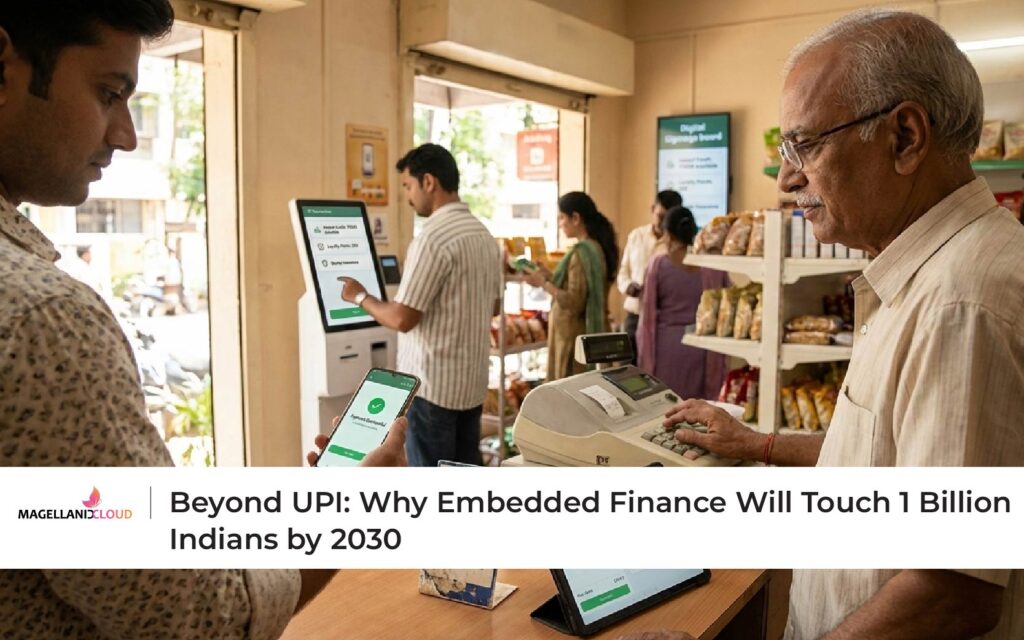
Ten years ago, paying digitally in India felt novel. Today, it feels automatic. A scan, a tap, a confirmation beep, and the transaction disappears into the background of daily life. UPI did not just change how Indians pay. It changed how Indians expect finance to behave.
But here is the quiet shift underway. Payments are no longer the destination. They are becoming the entry point. The next phase of India’s financial evolution will move far beyond UPI, into something more deeply integrated, more contextual, and far more powerful: embedded finance.
By 2030, embedded financial services will not feel like banking at all. They will feel like everyday actions. And they are likely to touch nearly 1 billion Indians.
Why UPI Was Only the Beginning?
UPI is often described as a payments success story, but its real achievement was infrastructural. It normalised real-time digital money movement at population scale. According to NPCI data, UPI processed over 12 billion transactions per month in 2024, making India the global leader in real-time payments.
This scale did two things simultaneously. It created trust in digital finance, and it embedded financial behaviour into non-financial contexts. Food delivery, ride hailing, retail shopping, utility payments, and even temple donations became digitally mediated.
Once payments became frictionless, a larger question emerged. If money can move invisibly, why can’t credit, insurance, savings, or investment do the same?
What Embedded Finance Actually Means?
Embedded finance refers to the integration of financial services directly into non-financial platforms. Instead of visiting a bank or fintech app, users access financial products exactly where they need them.
A small merchant gets instant credit inside a commerce app. A farmer receives crop insurance bundled with agri-inputs. A gig worker accesses micro-savings within a work platform. A consumer gets buy-now-pay-later options inside a checkout flow.
The financial service does not feel separate. It feels native.
According to Bain & Company, embedded finance could account for over $7 trillion in transaction value globally by 2030, with emerging markets driving a large share of adoption. India, with its digital public infrastructure, is uniquely positioned to lead this shift.
Why India Is the Perfect Market for Embedded Finance?
India’s embedded-finance opportunity rests on three structural advantages.
First, digital public rails. Aadhaar, UPI, DigiLocker, and Account Aggregator frameworks allow identity, consent, payments, and data sharing at scale. The World Economic Forum has highlighted India’s digital public infrastructure as a global reference model.
Second, platformisation of the economy. Millions of Indians now live, work, shop, and transact inside platforms. These platforms already understand user behaviour, risk patterns, and transaction flows.
Third, financial inclusion demand. Despite progress, a significant portion of India’s population remains under-insured, under-invested, or under-served by traditional banking. Embedded finance meets users where they already are, lowering adoption barriers.
Together, these forces create conditions where financial services can scale faster than traditional branch-led models ever could.
From Payments to Credit, Insurance, and Wealth
The earliest embedded-finance use cases in India focus on credit. Buy-now-pay-later, merchant working capital, and micro-loans have grown rapidly.
According to RedSeer, India’s embedded lending market is expected to grow at over 30% CAGR over the next decade. But the real expansion will come from non-credit products.
Insurance is increasingly embedded at the point of risk. Ride insurance during travel. Device insurance at checkout. Health coverage linked to employment platforms. Swiss Re estimates embedded insurance will grow faster in Asia than any other region.
Wealth and savings will follow. As more Indians earn digitally, embedded savings nudges, goal-based investments, and robo-advisory tools will become part of everyday apps rather than standalone products.
Trust, Data, and the Embedded Finance Challenge
Embedded finance cannot succeed without trust. When finance becomes invisible, accountability must become visible.
Customers must know who holds their data, who carries risk, and how decisions are made. This is why regulation, governance, and technology architecture matter as much as product design.
India’s Digital Personal Data Protection Act (DPDP Act) places responsibility on data fiduciaries to ensure consent, purpose limitation, and security.
At the same time, RBI has emphasised responsible digital lending and transparency in embedded-credit models.
Embedded finance succeeds only when systems are secure, explainable, and compliant by design.
Why Technology Is the Real Enabler?
Behind every embedded-finance experience sits a complex technology stack. APIs, cloud infrastructure, AI risk engines, data pipelines, and real-time monitoring systems must work seamlessly.
Study notes that organisations attempting embedded finance without robust data and cloud foundations struggle to scale responsibly. This is where many experiments fail. The interface looks simple, but the backend lacks resilience, governance, or intelligence.
India’s Next Billion Users Will Experience Finance Differently
By 2030, India’s next billion users will not “adopt fintech.” They will encounter finance as part of daily life.
They will not apply for loans. Credit will appear when needed.
They will not browse insurance. Coverage will activate contextually.
They will not open investment accounts. Savings will happen automatically.
This shift will blur the lines between banks, fintechs, platforms, and enterprises. Success will depend on partnerships, not silos.
Magellanic Cloud’s Role in India’s Embedded-Finance Future
At Magellanic Cloud Limited (MCL), we see embedded finance not as a feature, but as a system-level transformation. Through Finoux, we help enterprises deploy the financial foundations required for this shift.
Our work focuses on building secure, scalable, and compliant financial ecosystems that integrate seamlessly into non-financial platforms.
MCL supports organisations by:
- designing cloud-native architectures for high-volume financial transactions
- building AI-driven risk and decision engines with explainability
- enabling real-time data pipelines aligned with consent frameworks
- embedding governance, security, and compliance into system design
- supporting partnerships between enterprises, fintechs, and financial institutions
As India moves beyond UPI, the challenge is no longer whether embedded finance will happen. It is whether it will happen responsibly, securely, and at scale.
MCL’s role is to help enterprises meet that challenge, turning embedded finance into a sustainable growth engine rather than a short-term experiment.
The Road to 2030
UPI showed what was possible when infrastructure, policy, and technology aligned. Embedded finance will build on that foundation, expanding access to credit, insurance, savings, and wealth for hundreds of millions of Indians.
The next decade will not be defined by who builds the most apps. It will be defined by who designs the most trusted financial systems.
Embedded finance is not about hiding finance. It is about making finance work where life already happens.
And in India, that future is already taking shape.