Go Digital or Go Home: The Harsh Reality of Modern Enterprise Survival
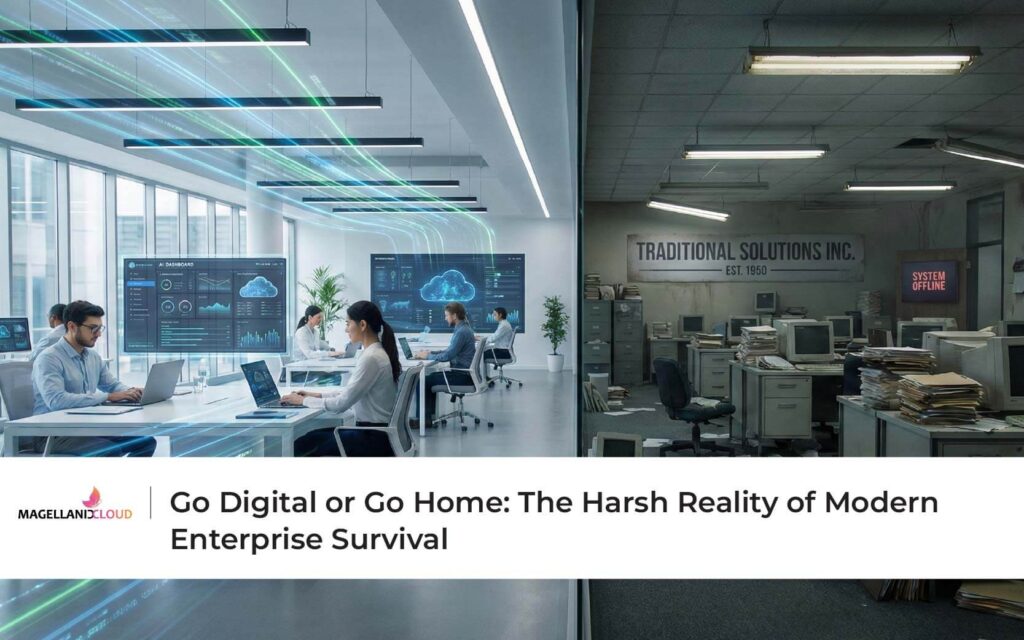
The modern enterprise is standing at a crossroads. One path leads toward agility, relevance, and resilience. The other quietly leads to stagnation. The difference between the two is no longer vision, intent, or even ambition—it is execution.
As markets accelerate and customer expectations evolve, businesses are discovering an uncomfortable truth: operating the way they always have is no longer sustainable. Technology has moved from the background to the boardroom. And with it comes a pressing question—are enterprises adapting fast enough to survive?
This is not a debate about innovation for innovation’s sake. It is about survival in an environment where speed, intelligence, and adaptability decide who stays relevant and who fades out.
Why Standing Still Is the Biggest Risk
For decades, stability was considered a strength. Mature processes, fixed workflows, and proven operating models were seen as assets. Today, those same attributes can become liabilities.
Markets no longer move in predictable cycles. Customer preferences shift in real time. Competitors emerge from unexpected places—often digital-native companies with lean structures and rapid execution. In this environment, the biggest risk is not disruption itself, but hesitation.
Research reflects this urgency. 67% of business leaders believe their company will lose its competitive edge if they fail to modernize their operations. That number is telling. It signals a collective recognition that transformation is no longer a strategic advantage-it is table stakes.
The Customer Has Changed-Forever
One of the strongest forces driving enterprise change is the customer. Today’s customers expect immediacy, personalization, and consistency across channels. They want answers now, experiences tailored to their needs, and interactions that feel seamless rather than fragmented.
Legacy systems and manual processes struggle to keep up with these expectations. Siloed data prevents a unified view of the customer. Slow decision-making leads to missed moments. Rigid workflows make personalization difficult at scale.
Organizations that respond successfully do so by rethinking how they operate from the customer’s point of view—leveraging data, automation, and integrated platforms to anticipate needs instead of reacting late.
This is where Digital Transformation becomes a strategic enabler rather than a technology project. It allows enterprises to move from transactional interactions to intelligent, adaptive experiences that build loyalty over time.
Competitive Disruption Is No Longer Predictable
Disruption used to come from within industries. Now, it arrives from outside them.
Fintech challenged traditional banking. E-commerce reshaped retail. Cloud-native startups redefined software delivery. What these disruptors share is not just technology, but operating models designed for speed and scale.
Traditional enterprises often struggle to respond because their systems were built for control, not change. Launching new services takes months instead of weeks. Integrating new tools becomes complex and costly. Innovation stalls under layers of approval and outdated infrastructure.
It’s no surprise, then, that 81% of business leaders now view investment in digital initiatives as essential or necessary for long-term success. The message is clear: modernization is no longer optional—it is foundational.
Remote and Hybrid Work Have Redefined Operations
The workforce has changed just as dramatically as the market.
Remote and hybrid work models are no longer exceptions. They are permanent features of modern enterprises. This shift has exposed the limitations of legacy processes that depend on physical presence, paper-based workflows, or disconnected systems.
To operate effectively, organizations need real-time visibility, secure access to systems from anywhere, and collaboration tools that enable distributed teams to function as one. Decision-making can no longer wait for weekly meetings or manual reports. It must happen continuously, based on live data.
Enterprises that embrace flexible, digital-first operations are discovering something unexpected: not only do these models support remote work, they also unlock productivity, transparency, and faster execution across the organization.
Automation Is No Longer About Efficiency Alone
Automation was once viewed primarily as a cost-saving measure. Today, it plays a much larger role.
Modern automation enables faster decision-making, reduces human error, and frees teams to focus on higher-value work. It allows organizations to scale operations without scaling complexity. And it turns data into action, rather than letting insights sit idle.
What’s particularly telling is how leaders measure success. 81% of executives now use productivity improvements as a primary ROI metric for modernization initiatives. This shift reflects a broader understanding: efficiency alone is not enough. Enterprises must become smarter, faster, and more adaptive.
At its core, Digital Transformation enables this shift by embedding intelligence directly into workflows—so systems don’t just support work, they actively improve it.
The Reality Check: Everyone Else Is Moving
For organizations still debating whether to act, the broader market offers a reality check.
94% of large organizations in the US and UK already have a formal modernization strategy in place. That means the question is no longer “should we change?” but “how fast can we keep up?”
Falling behind today does not just mean slower growth. It means higher operating costs, reduced customer trust, and shrinking relevance. In competitive markets, delay compounds quickly.
From Technology Adoption to Organizational Agility
The most successful enterprises understand that modernization is not about tools alone. It is about mindset.
True agility comes from aligning people, processes, and technology around continuous improvement. It requires breaking down silos, empowering teams with data, and designing systems that can evolve as conditions change.
This is where Digital Transformation delivers its greatest value—not as a one-time initiative, but as a continuous capability that allows enterprises to sense, respond, and adapt faster than their environment.
Future Outlook: Adaptation as a Continuous Advantage
Looking ahead, the pace of change will only accelerate. Artificial intelligence, intelligent automation, and real-time analytics will continue to reshape how enterprises operate. Customer expectations will rise further. Competitive cycles will compress even more.
In this future, resilience will not come from size or legacy. It will come from adaptability.
Organizations that treat transformation as an ongoing journey—rather than a finite project—will be best positioned to thrive. They will make decisions faster, respond to disruptions with confidence, and turn uncertainty into opportunity.
The message is not meant to alarm—but to clarify.
Modern enterprise survival no longer depends on whether change is coming. It depends on whether organizations are ready to move with it.
Adapt now, or risk being left behind.